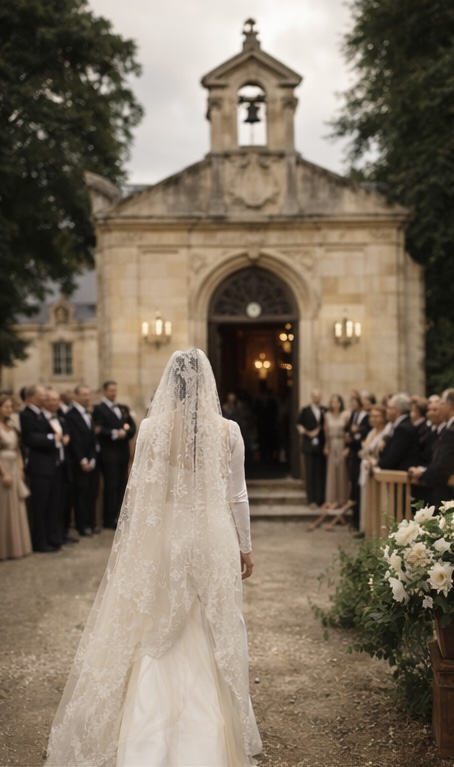
There are few things quite as transformative as lace.
A bride may be wearing the simplest of gowns, her hair loosely swept back, almost nothing in the way of jewellery. Then the veil is placed upon her head and, suddenly, everything changes. The softness around the face, the extraordinary workmanship, the length of lace falling behind her — it is the moment she becomes a bride.
Perhaps this is why the lace veil has endured when so many other wedding fashions have disappeared.
Across Europe, lace has long accompanied life’s most important ceremonies. It appears at weddings and christenings, in family portraits and carefully wrapped boxes passed from one generation to another. In aristocratic houses, particularly, beautiful old veils are still discovered in attics and linen cupboards: metres of handmade lace folded between tissue, sometimes accompanied by a faded photograph or a handwritten name.
These are not simply old textiles. They are fragments of family history.
The Aristocratic Lace Veil
For centuries, lace was among the great expressions of European craftsmanship. Venetian needle lace, delicate French laces and the extraordinary work of generations of lacemakers transformed thread into something almost architectural in its intricacy.
The finest pieces took an astonishing amount of time to create, and naturally became precious possessions. A magnificent veil might therefore survive long after the wedding for which it was originally made.
That tradition remains particularly visible in European royal and aristocratic weddings. Princesses across the Continent have repeatedly chosen lace for their wedding veils — sometimes wearing an historic family veil, sometimes commissioning a new one intended to become an heirloom in its own right.
There is something wonderfully resistant to fashion about it.
A lace veil does not need to be modernised. Its beauty lies precisely in its sense of continuity.
The Transformative Power of a Veil
The most beautiful veils have presence without heaviness.
A long lace veil can transform even the most restrained wedding dress. Against silk or satin, the intricacy of the lace suddenly becomes visible; against bare skin, its flowers and scrolls appear almost drawn onto the body.
And then there is movement.
A veil caught by a little air as a bride walks through a church doorway or across the stones of an old palazzo has a romance that cannot really be replicated by anything else. In photographs, it creates softness and drama. In person, it gives the bride an almost ceremonial presence.
This is perhaps the secret of the lace veil: it doesn’t merely accessorise the dress. It changes the atmosphere.
Lace Made to Be Passed Down
There is another reason to choose lace.
The wedding dress may eventually be carefully packed away, but a veil can have another life. It can be lent to a daughter, granddaughter, niece or goddaughter. It can be altered without losing its soul. A fragment of antique lace can even find its way onto a christening gown many years later.
This idea of continuity feels increasingly precious.
The most luxurious things are not necessarily those bought for one perfect occasion, but those beautiful enough to survive it.
A lace veil acquires meaning with every person who wears it. The tiny imperfections, the softened ivory colour of old thread, even a careful repair become part of its history.
The Beauty of the Christening Gown
The same romance belongs to the traditional lace christening gown.
Few garments are more fleetingly worn or more lovingly preserved. Long after the child has outgrown it, the gown remains — wrapped carefully and waiting for another generation.
The finest examples have extraordinary proportions: clouds of fine cotton, silk, embroidery and lace falling far beyond a baby’s feet. They were never designed for practicality. They were created for ceremony.
And that is precisely their charm.
A beautiful christening gown turns one small family moment into something that feels connected to generations before and, perhaps, generations still to come.
Lace in Venice
There could hardly be a more evocative place in which to discover such pieces than Venice.
At The Héritage Tea Rooms & Boutique, lace belongs naturally to the surroundings. In a city whose history is inseparable from extraordinary craftsmanship, the boutique brings together pieces that feel less like conventional occasionwear and more like objects to be treasured.
Among the most spectacular are its lace christening gowns — romantic, exquisitely detailed creations with the presence of future heirlooms — alongside beautiful lace wedding veils.
Seen in Venice, they somehow make complete sense.
There is the faded grandeur of the city outside, the stone and water, old palazzi and centuries of decorative arts; and inside, the delicacy of lace, preserved and reimagined for another generation.
It is a reminder that true luxury need not shout. Sometimes it is simply hundreds of tiny stitches, the work of skilled hands, and something beautiful enough that nobody can quite bring themselves to throw it away.
That is the romance of lace.
It begins as thread, becomes part of a celebration, and ends as an heirloom.