Where timeworn beauty, quiet elegance and the rituals of everyday life come together.
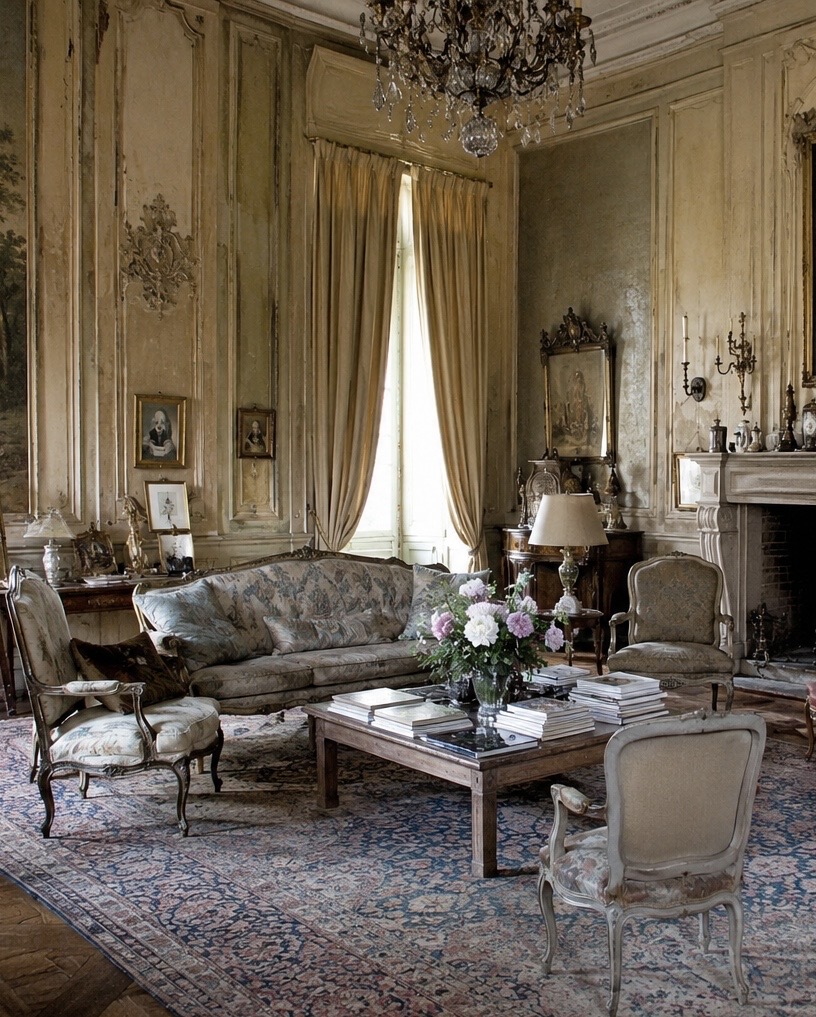
There is something unmistakable about a French sitting room. Rarely perfect, never overly arranged, it possesses a kind of beauty that seems to have settled into place over generations. A faded fauteuil beside the fire, linen curtains moving gently at an open window, an old portrait hung above a marble mantel, books gathered wherever there is room for them. Nothing appears hurried, and very little feels new.
Perhaps that is its greatest appeal.
In the French countryside, the sitting room has traditionally been less a showcase than a place in which life unfolds. It is where coffee is taken after lunch, where shutters are drawn against the afternoon heat, where friends linger long after dinner and where, in winter, everyone gravitates towards the fire.
Its elegance comes not from decoration alone, but from atmosphere — from rooms that have been allowed to acquire character slowly.
A Room Shaped by Time
The most beautiful French interiors rarely belong entirely to one period.
An eighteenth-century commode might sit beneath a nineteenth-century mirror. A Louis XV chair may be upholstered in a simple linen rather than precious silk. An inherited table stands comfortably beside a lamp found decades later at a brocante.
It is this gentle layering that gives the French sitting room its particular ease.
Rather than attempting to make everything correspond, there is confidence in allowing different pieces to coexist. Furniture may carry scratches and softened edges. Gilding fades. Stone bears the marks of generations. Old floorboards creak beneath rugs worn thin in places.
These imperfections are not necessarily things to disguise. They are part of the room’s history.
The result is an interior that feels collected rather than decorated.
The Architecture Comes First
In a château, manor house or modest maison de campagne, the architecture often provides much of the decoration.
Tall windows bring changing daylight into the room. Plaster mouldings cast delicate shadows across walls. Limestone fireplaces, old beams, panelled doors and terracotta or parquet floors create a richness that requires surprisingly little embellishment.
French rooms are particularly beautiful when these original elements are given space to breathe.
Walls might remain in chalky whites, warm creams, faded stone or the palest grey-blue. Rather than competing with antique furniture, these quiet colours become a backdrop for it.
And then there are the windows.
Long curtains in linen, cotton or an old-fashioned printed fabric soften their proportions without overwhelming them. In summer, shutters filter the fierce midday sun; by evening, the windows are opened again and the room fills with the sounds and scents of the garden.
The relationship between indoors and outdoors is an essential part of French country life.
The Beauty of Things with a Past
A French sitting room is difficult to recreate entirely with new things.
Its character lies in objects that seem to have lived another life before arriving there: an antique mirror whose silver has begun to fox, a stack of old books, a porcelain bowl, a landscape painting discovered at a village market, a slightly threadbare Aubusson-style rug.
None needs to be particularly valuable.
Indeed, some of the most charming pieces are those found inexpensively at brocantes and vide-greniers — objects chosen because of their shape, patina or simple usefulness rather than their provenance.
This is where French interiors offer a lesson worth remembering: age itself can be decorative.
A chipped urn filled with branches can be more compelling than a pristine new vase. A linen sheet inherited from a grandmother might become a curtain or cover a favourite armchair. An old farm table, scrubbed pale through decades of use, carries a beauty that cannot easily be manufactured.
The room becomes richer because its objects have stories.
Comfort, the French Way
For all their elegance, the best French sitting rooms are deeply comfortable.
Armchairs invite you to sit. Sofas are generous rather than sculptural. Cushions soften formal furniture, and small tables appear exactly where one might want to place a book or a glass of wine.
The effect is relaxed, but never careless.
Natural fabrics are particularly at home here: washed linen, cotton velvet, wool, ticking, toile and faded florals. Patterns need not match. A striped cushion can sit happily against an antique floral textile; a plain linen sofa can be given warmth by an embroidered cushion or an old tapestry.
What holds everything together is restraint.
There is usually somewhere for the eye to rest.
Flowers Without Ceremony
Flowers in a French country room rarely need elaborate arranging.
Garden roses gathered loosely into a jug, lilac branches in an old vase, hydrangeas beginning to fade at the edges or a handful of herbs brought in from the garden can be enough.
Their informality is important.
A grand room becomes immediately more intimate when its flowers look as though they were cut only moments before. Even in winter, bare branches, dried hydrangeas or greenery from the garden bring life to an interior.
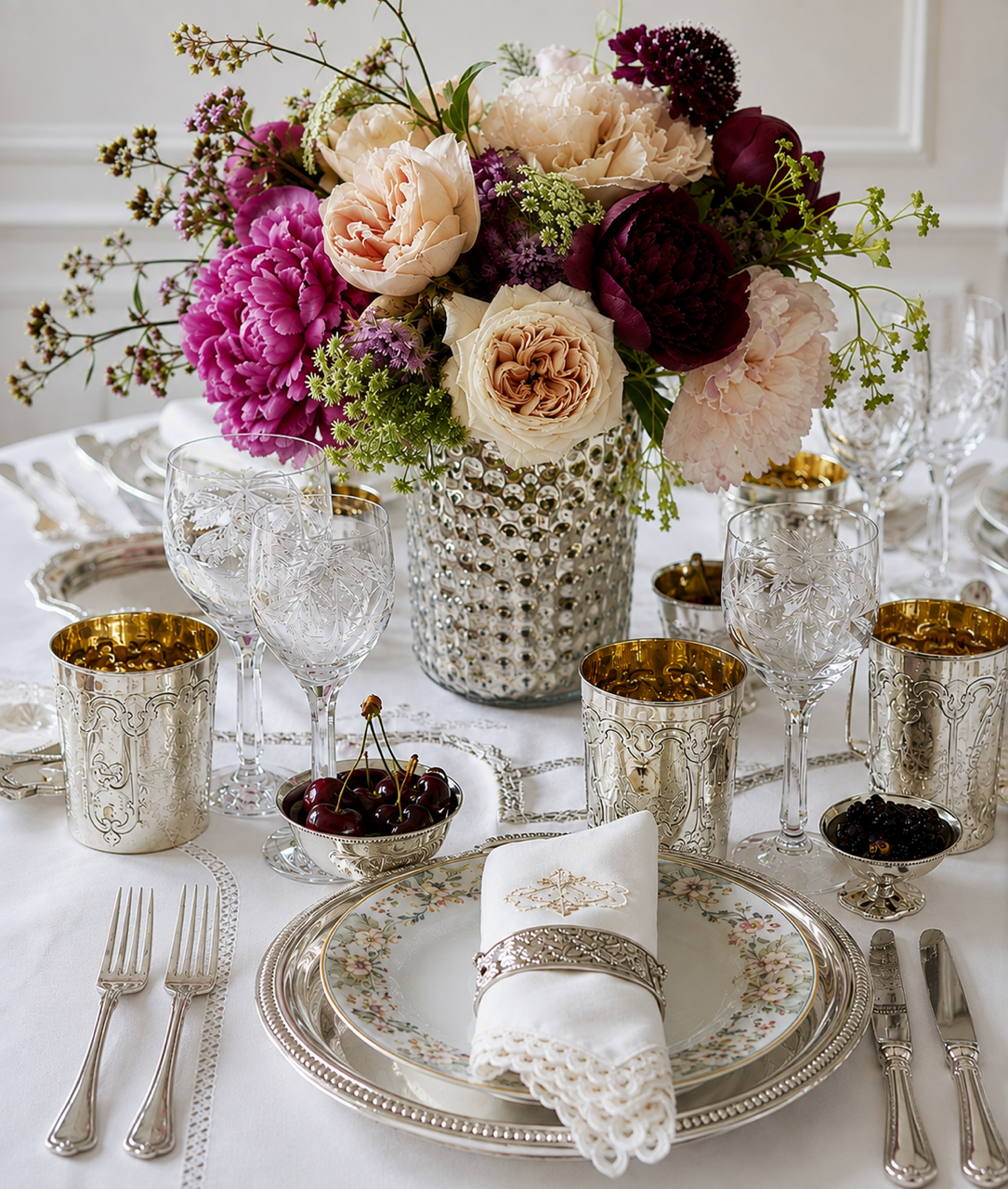
The vessel matters almost as much as the flowers: old confit pots, silvered vases, pharmacy jars, ceramic pitchers and simple glass bottles all possess an ease that a formal arrangement sometimes lacks.
Rooms for Living
Perhaps the most enduring lesson of the French sitting room is that beauty and daily life need not be separated.
A beautiful room can contain a half-read book.
There may be a tea tray left on the table, a basket beside the fire, spectacles resting on a pile of magazines or flowers dropping their petals onto an old cloth.
These traces of life prevent elegance from becoming precious.
French country interiors often appear effortless because they have not been arranged solely to be looked at. They have evolved around habits: reading by a particular window, taking coffee at a certain table, moving an armchair closer to the fireplace each winter.
Over time, those habits become part of the decoration.
Creating the Feeling at Home
One does not need a château — or even a house in France — to borrow something from this way of living.
Begin slowly.
Choose fewer things, but choose those that you genuinely want to keep. Look for old furniture with pleasing proportions rather than perfect condition. Allow natural materials to show their age. Mix humble pieces with something beautiful. Bring flowers and branches indoors. Leave books within reach.
And resist the temptation to finish the room all at once.
The loveliest French sitting rooms possess a certain looseness precisely because they have developed over years. There is always space for another painting found on a journey, another chair discovered at a market, another object whose purpose is simply to be loved.
A room becomes personal through accumulation, editing and time.
That may be the true secret of French country style.
Not a prescribed palette. Not a particular antique. Not even the architecture.
It is the understanding that a home can be elegant without being immaculate, beautiful without being formal, and deeply considered without ever appearing contrived.
The French sitting room endures because it reminds us that the most memorable interiors are not simply decorated.
They are lived in.