From a painful turning point to a life shaped by faith, creativity and family, the Florentine jewellery designer speaks to Blue Ribbons & Lace about finding her way — and discovering what she truly values.
Elena Braccini went into a Florentine jewellery shop looking for a wedding present for her best friend. She wanted something beautiful, certainly, but above all something meaningful: a gift that would accompany someone she loved through life.
Beside the counter, a goldsmith was working. Watching his hands, she found herself speaking aloud.
“How I would love to learn to make something with my own hands!”
He turned towards her. Together with other artists and craftspeople, he had recently established a school of sacred art. Would she like to visit?
It was an unexpected invitation, and one that would help Elena discover a vocation. But the story behind her jewellery begins with a much more personal search: the need to find herself again.
While pregnant with her second daughter, Elena experienced the breakdown of her relationship. She returned from Rome to Florence, close to her family, facing the prospect of beginning again with two young children. She speaks candidly about the depression and uncertainty that followed, recalling days when getting out of bed felt almost impossible. Her daughters gave her a reason to keep going; she still needed to find a way forward for herself.
A friend took her to a sanctuary in Montelupo. There, an encounter with a nun helped her reconnect with a faith she had partly lost.
“It was as though, after so much darkness, someone had opened a window and let in a wonderful light.”
What followed took time. Faith helped her regain her footing; studying at Florence’s Sacred Art School gave her a place to learn, exchange ideas and discover what she could create. Gradually, she began to build something of her own.
The sacred icons that now distinguish her jewellery belong to this journey. Rendered in vivid colour or painted by hand in exquisite miniature, they express convictions formed through experience: the importance of hope, the comfort of feeling accompanied and the strength an apparently small object can hold. For Elena, their meaning is inseparable from the life she rebuilt.
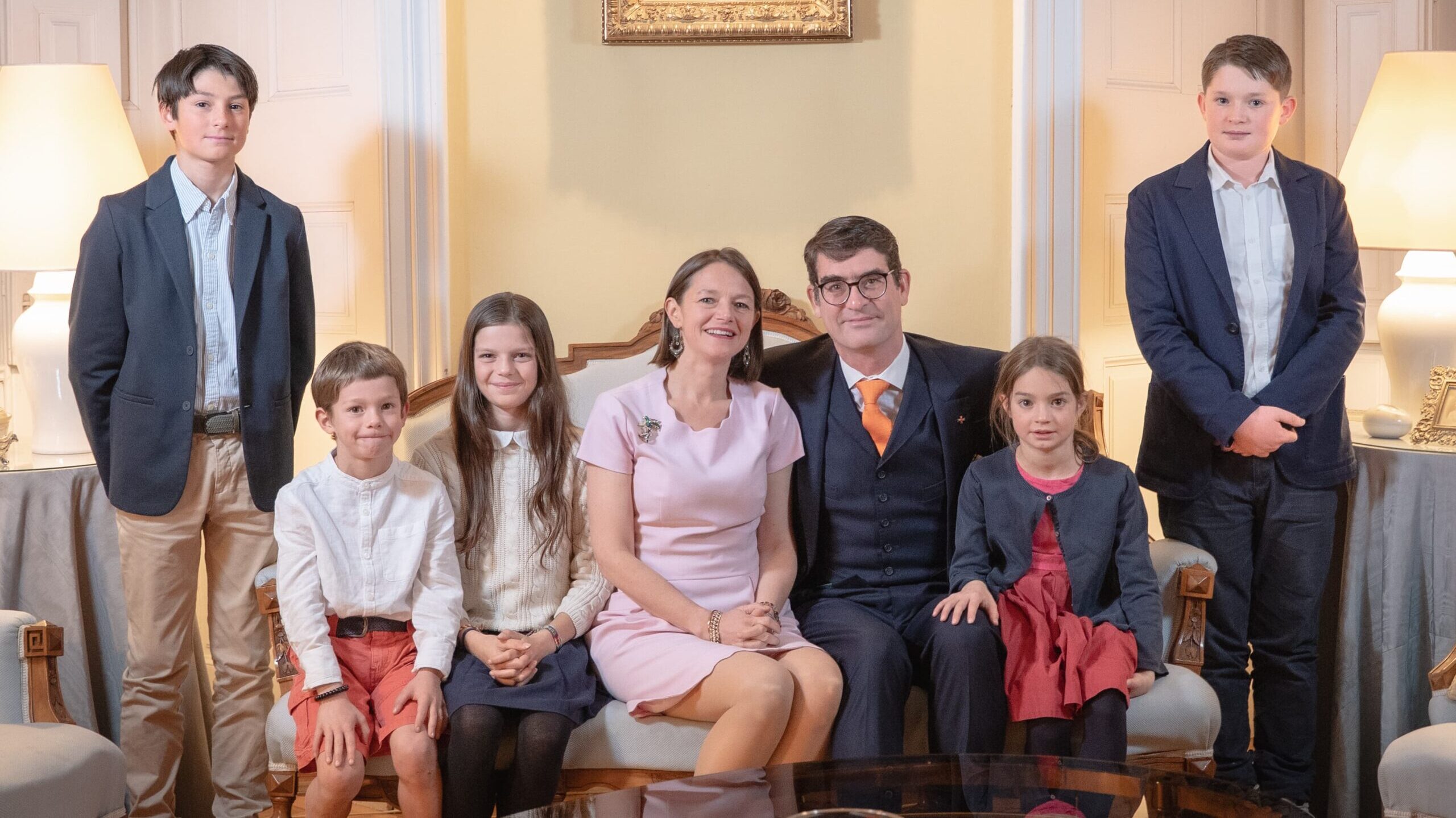
Today, she has returned to Fiesole, the hillside town she once dreamed of leaving. Her home holds the colours, curiosities and memories gathered on her travels. She works with Florentine craftspeople whose skill she describes with open admiration. And she has a happy family life, with her husband and three children, including a little boy named after the Archangel Gabriel.
There is pleasure in the details she shares: birdsong outside the window, an object discovered in a tiny workshop, a Florentine steak and a good glass of Brunello around the table. She knows what these things are worth to her.
In conversation with Blue Ribbons & Lace, Elena tells a story that reaches far beyond jewellery. It is an account of self-discovery, of finding the courage to begin again and of creating a life she can recognise as her own.
“As a girl, I dreamed of leaving,” she says of Fiesole. “Today, I consider it a privilege to return.”
Elena, you were born in Fiesole, overlooking Florence. When you think of your childhood, what comes back to you?
I was born in a residential area surrounded by greenery, just outside Florence. As a girl, though, I found that peaceful place a little confining. I had an enormous desire to discover the world, to travel, to see new places and experience different things. I dreamed of leaving, of going far away, and eventually that is exactly what I did.
Then, around the age of thirty, when I returned to Florence, something changed. I began to see Fiesole through completely different eyes, rediscovering everything I perhaps hadn’t appreciated when I was younger: the tranquillity, the silence, the closeness to nature, the birdsong. I realised how much I had missed it all.
My parents and my brother still live in the house where I grew up. At a certain point, I felt the desire to return to my roots, so I bought a house in Fiesole myself. I wanted to rediscover that more authentic, peaceful way of life.
It is curious how sometimes we have to go far away to understand how special the place we come from really is. As a girl, I dreamed of leaving; today, I consider it a privilege to return.
Your journey into jewellery began while you were choosing a wedding present for a friend. What happened that day?
I was looking for a special gift for my best friend, who was about to get married. I wanted something that wasn’t simply beautiful, but deeply meaningful — something that would stay with her over the years.
I went into one of Florence’s best-known jewellery shops and was particularly struck by a ring with a cross and a small diamond. While a lady was showing me the jewellery, I noticed a goldsmith working beside the counter.
I was fascinated by his ability to create something so precious with his own hands. Almost without thinking, I said aloud: “How I would love to learn to make something with my own hands!”
He turned to me and explained that, together with other artists and craftspeople, he had just established a school of sacred art. He invited me to visit.
I accepted, and that was where everything began. What seemed like a chance encounter became the beginning of a path I could never have imagined.
I like to think it all began with the desire to give a meaningful gift. Ultimately, that is still what I try to convey through my jewellery: beauty, but also emotions, symbols and stories to carry with you.
What did studying at Florence’s Sacred Art School reveal to you?
It was an extraordinary experience, above all on a human and artistic level. People came from all over the world: young artists, but older people too, united by a deep spirituality and the desire to express their creativity through working with their hands.
The teaching ranged from goldsmithing to sculpture, painting and cabinetmaking. Alongside the practical work, we studied different religious traditions and their spiritual meaning.
What fascinated me most was the daily contact with people of extraordinary talent and sensitivity. I remember our days together with great emotion, watching wonderful works emerge almost from nothing. An idea, an intuition or simply an emotion could take shape as something unique.
Everyone brought their own history, culture and way of interpreting art. We learnt from our teachers and from one another.
That was perhaps the greatest gift: understanding that art also involves sharing, sensitivity and the ability to give form to what we feel inside.
You have spoken about your work growing from renewed faith and gratitude. Would you tell us about that part of your life?
I went through one of the most difficult periods of my life when the father of my daughters left me while I was pregnant with our second little girl.
I was living in Rome and suddenly found myself having to start all over again. I returned to Florence, close to my family, but inside I was in profound pain. I went through a period of vulnerability, depression and bewilderment. I had lost my peace of mind, my confidence and, in some ways, myself. There were moments when even getting out of bed seemed impossible.
My little girls were my most important reason to carry on, but I also needed someone to help me find my own way again.
A very dear friend played a fundamental role. One day, she said: “I want to take you somewhere. There is someone I would like you to meet.”
She took me to a sanctuary in Montelupo, where I met a nun. That encounter changed something deep within me. I still remember her words, the way she spoke and the serenity she conveyed. It was as though, after so much darkness, someone had opened a window and let in a wonderful light.
Through that encounter, I rediscovered my faith and my connection with Our Lady.
Faith did not make the difficulties disappear, but it taught me to face them with a different spirit. It helped me take hold of my life again and, above all, be present for my daughters, growing alongside them.
For me, faith has been a light that helped me find my way again when I thought I had lost it.
The image of Our Lady associated with Rue du Bac in Paris has become central to your collections. What does it mean to you personally?
After meeting Sister Elvira at the sanctuary in Montelupo, I began to feel an ever-stronger connection with Our Lady of the Miraculous Medal.
I wanted to understand it more deeply, so I began reading and exploring its history. I was particularly fascinated by the account of the apparitions in Paris in 1830, when the Virgin Mary appeared to Saint Catherine Labouré and asked her to have a medal struck according to the design she had shown her.
The idea that such a small, simple object could hold so much spiritual meaning, becoming a symbol of protection, comfort and hope, touched me enormously.
That was when I thought: why not bring together my passion for goldsmithing and the faith I had rediscovered?
I wanted to create jewellery that could be worn every day, small symbols to keep close. Jewellery that could offer comfort in difficult moments and remind the person wearing it that they are never alone.
Each sacred icon still represents a small sign of love, hope and protection for me. It is a way of sharing the light I was fortunate enough to rediscover.
Colour gives your sacred icons such a distinctive character. How do you choose it?
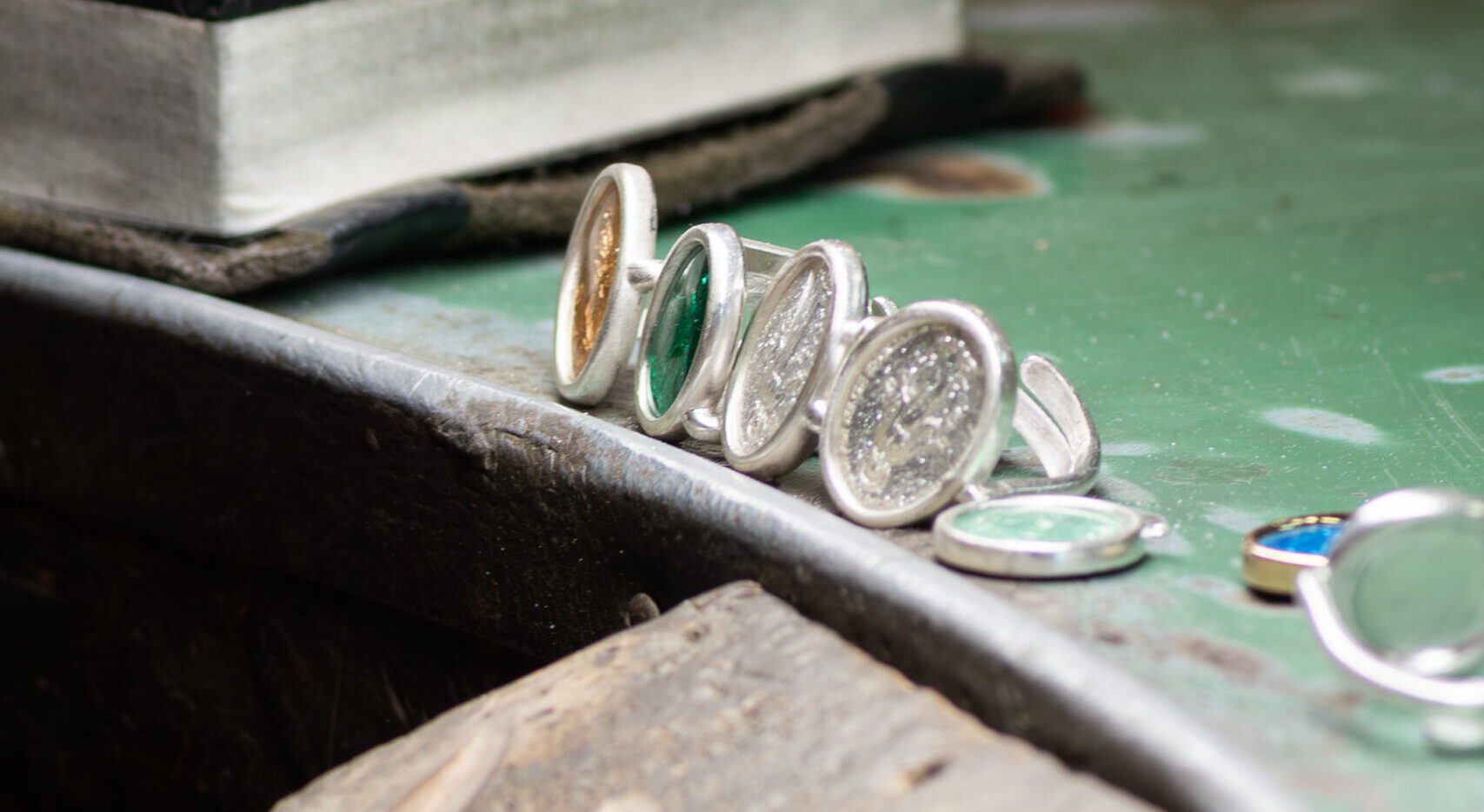
I wanted to reinterpret them in a contemporary way, making them beautiful, refined and pleasurable to wear, while preserving their spiritual meaning.
I introduced colour through enamels, which also help protect them from wear.
Traditionally, Our Lady is associated with pale blue, the colour of her mantle, but I liked experimenting with stronger, more vibrant shades: red, purple, green and pink.
My choices often come from my mood and whatever inspires me at that moment. There are periods when I feel particularly drawn to red, others when I prefer purple or more delicate shades. It is very spontaneous.
At first, it was something of a gamble. I didn’t know how such a colourful interpretation of an important religious symbol would be received. But I wanted to create something that truly reflected my personality.
I think the beauty lies in preserving the spiritual meaning while allowing everyone to choose a colour that expresses who they are, reflects their character or simply captures the emotion of a moment.
Your hand-painted miniatures invite us to look very closely. How did they come about?
The idea grew out of my love of artistic craftsmanship and my search for exceptional makers who preserve ancient traditions.
Florence is full of small workshops where remarkably refined skills survive. I love discovering these places, getting to know the craftspeople and watching them work.
During one of these searches, I discovered a tiny Florentine workshop, known to collectors from all over the world. An immensely experienced master craftsman works there, creating miniatures painted entirely by hand with brushes so fine they are almost imperceptible.
What struck me was his ability to contain an entire work of art within such a tiny space, through the most delicate movements.
I thought: why not apply this technique to my sacred icons?
Each one requires a great deal of time, concentration, patience and artistic sensitivity. It becomes a small work of art, with all the nuances and individual details that only a master’s hand can give it.
What moves me most is bringing together two worlds to which I feel deeply connected: the spirituality of these sacred icons and the excellence of Florentine artistic craftsmanship.
You began by making the jewellery yourself. What has working with experienced Florentine goldsmiths taught you?
In the beginning, it all started almost playfully, from a passion I pursued enthusiastically. I devoted great care to every creation, although the work took an enormous amount of time.
Little by little, I began showing my jewellery to the people around me. To my surprise, they liked it, were interested in it and, above all, were moved by it.
As demand grew, I understood that I needed experienced hands to help develop the project. Eventually, I came to a prestigious goldsmith’s workshop that has been operating since 1968. When they agreed to make my creations, it was an immensely emotional moment. I felt deeply proud.
But the most beautiful part has been meeting the master goldsmith, who is now ninety-four.
He is a man of rare sensitivity and mastery. Every time I watch him work, I am spellbound. His hands are large and strong, yet he handles the tiniest objects with incredible delicacy.
There is something profoundly poetic about his gestures, the naturalness with which he works, the precision of every movement.
I still have so much to learn from him: his approach to work, his respect for materials and his constant pursuit of perfection.
I believe that this is true luxury today: the time, experience and knowledge held in hands that have devoted an entire lifetime to creating beauty.
Your Fiorino collection pays tribute to Florence. What do you hope someone carries with them when wearing one of these pieces?
The decision to include the Fiorino grew out of my deep connection with Florence and my love for its beauty.
Every morning, when I look out of the window, I realise how fortunate I am to live somewhere so extraordinary.
When I was younger, I travelled extensively, discovering distant countries, different cultures and wonderful cities. Yet travelling taught me to appreciate Florence’s uniqueness even more.
Reinterpreting the Fiorino was a way of paying tribute to my city, my roots and the artistic and craft tradition that continues to inspire me.
I like to think that, through it, you can carry a little fragment of Florence, its history and its beauty with you, wherever you are in the world.
People often choose a sacred icon to celebrate a milestone or find comfort. What have your clients shared with you?
I would like everyone choosing one to be guided by what they feel: an emotion, a memory or simply something they cannot explain. I have always thought that, in some way, it is the sacred icons that choose people, rather than the other way around.
I do not make the icons themselves. I seek them out and choose them personally at the sanctuaries I visit during my travels, in Italy, across Europe and around the world. Each carries a story and a connection to a place.
Over the years, clients have shared wonderful, intimate stories with me. Through an icon, they have rediscovered a memory, found strength or a small sign in which to believe.
I treasure these stories. Running an independent brand is not always easy; there are sacrifices, difficulties and moments when everything feels complicated. These are the stories that give me the strength to continue and remind me why I began.
My greatest wish is for each jewel to find the right person and become something deeply personal to them.
Which jewels do you wear yourself?
They have become an essential part of me. They hold my story, my emotions and the most significant moments of my life.
I like to choose different jewellery from time to time, but there are certain sacred icons I never take off: Our Lady of the Miraculous Medal, Saint Michael the Archangel, Saint Benedict and Saint Rita.
Each of these figures has left a profound mark on my life, at different moments and for different reasons.
Wearing them makes me feel accompanied, protected and, somehow, stronger. They are a quiet but constant presence, reminding me of what I believe, what I have lived through and what I hold in my heart.
That is my idea of a jewel: something that belongs to us so deeply that it becomes part of who we are.
With your background in interior design, we would love a glimpse of your home. What does it reveal about you?
I smile, because although I began as an interior designer, I believe I have a deeply artistic and creative soul. I love colours, unexpected combinations and objects that tell a story.
My home has always reflected my personality: lively, eclectic, full of memories and apparently disparate things that, to my eyes, find their own harmony.
Travelling is one of my great passions, and I rarely return empty-handed. I love small objects, curiosities and unusual pieces that remind me of a place, an encounter or an emotion. I confess to being an almost compulsive collector of things brought back from my travels!
But life has a wonderful sense of humour: I remarried, and my husband is practically my opposite. He is an accountant; he loves order, clean lines, white and grey. I am an explosion of colour, creativity and mixed influences.
So we have learnt to find a balance — for the sake of family harmony too! Ultimately, that contrast makes our home even more interesting.
But there is one thing on which I haven’t compromised: every room must say something about me. A home should have a soul, hold memories and reflect the people who live there.
Mine continues to tell my story, one colour and one journey at a time.
When you gather the people you love around your table, what makes the evening unmistakably yours?
Certainly good food and good wine, especially red.
I have a deep connection with Tuscany’s food and wine traditions, partly because members of my family produce Brunello di Montalcino, a wine of which I am particularly proud.
For me, the table means sharing, family, the pleasure of being together and love for our roots. I love gathering over a traditional Florentine dish with a glass of excellent red wine, without rushing.
And if a proper bistecca alla fiorentina arrives at the table, perhaps accompanied by a good Brunello di Montalcino, then we are very close to perfection.
I believe that this is true luxury: knowing how to appreciate the beautiful things in life, especially when we can share them with the people we love.
You have spoken about finding luxury in simplicity. What does a beautifully lived day look like to you now?
That idea expresses something so profound about me and the philosophy of my brand that I chose to have it tattooed on my skin. It is an understanding I reached during one of the most difficult periods of my life.
I remember one summer in particular. I was pregnant with my second daughter and going through a painful time. While my children’s father spent his days aboard a luxury yacht, I was in Barcelona with my eldest daughter and a dear friend.
At a time when I might have felt deprived of so many things, I discovered that I already had what truly mattered.
I learnt to find happiness in small gestures, laughter, time spent together and the beauty of a simple day. I understood that luxury is what fills our hearts.
Today, that understanding is stronger than ever. My greatest luxury is spending time with my husband and my three children. A day outdoors, in the countryside or by the sea, a good glass of wine, something simple and delicious to eat, my children’s laughter and the pleasure of being together.
Thirteen years after my second daughter, I had a wonderful little boy, now ten months old. I wanted to name him after the Archangel Gabriel.
This is the feeling I try to convey through my jewellery: that true beauty lies in the stories we live, the memories we treasure and the love that accompanies us.
Because, for me, true luxury is recognising how precious what we have already is, and being able to share it with the people we love.
Interviewed by Elena Capel Cure