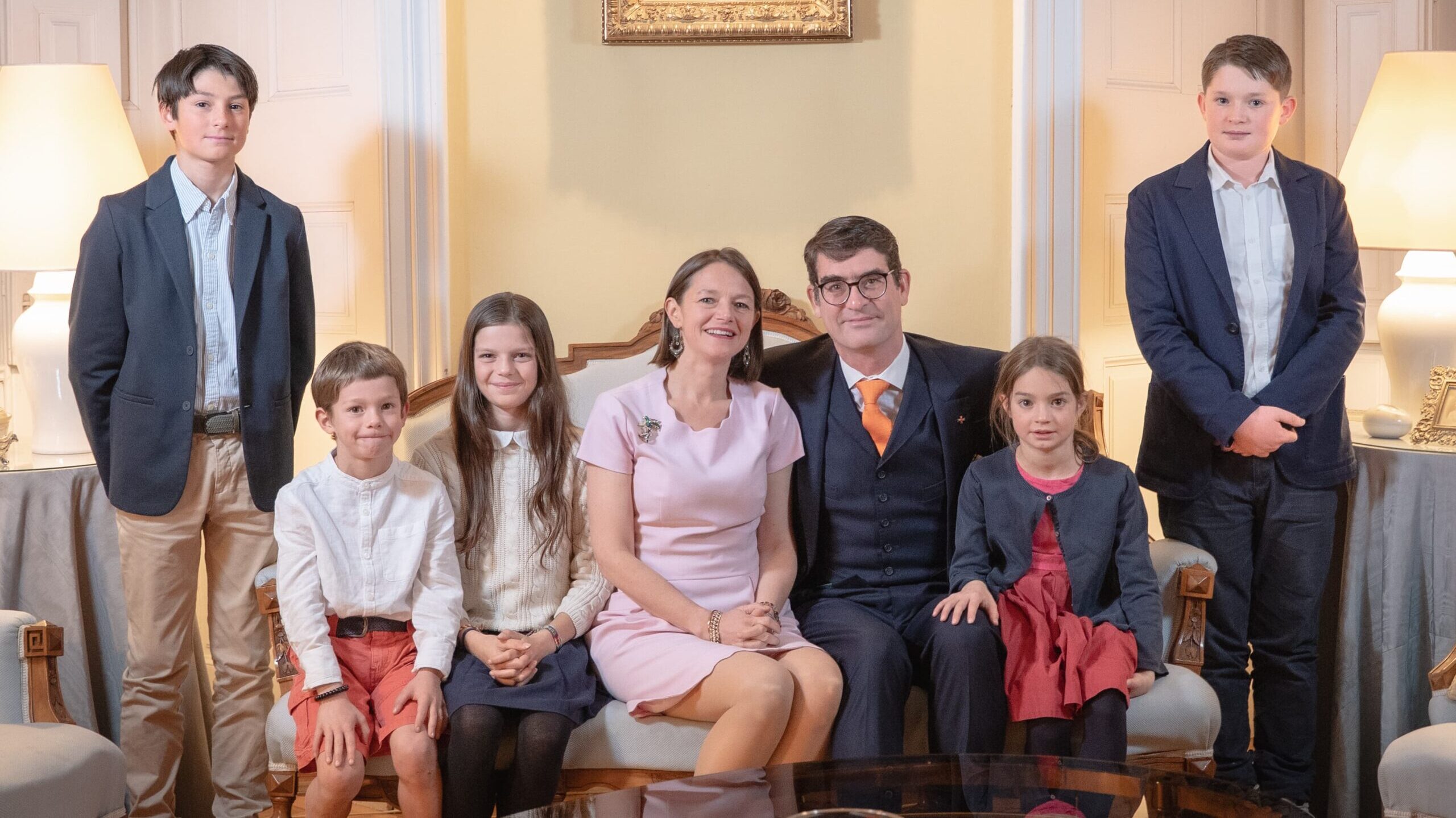
Parisian elegance, five children, centuries of history and a cowbell for lunchtime. Countess Alix de la Poëze d’Harambure-Fraye invites Blue Ribbons & Lace into the wonderfully unconventional world of family life at one of Austria’s most historic castles.
There are castles one visits to admire their history, and then there are castles where history is simply part of everyday life. At Schloss Artstetten, in the Austrian countryside, the two exist rather happily together.
For Countess Alix de la Poëze d’Harambure-Fraye, whose family history is inseparable from that of the Habsburg dynasty, Artstetten has always been home. Today, she lives there with her husband, François-Xavier Fraye, and their five children, in a world where centuries-old traditions coexist with schoolwork, Sunday lunches and the occasional search for a child who would rather be anywhere than at his homework desk.
Artstetten is, of course, no ordinary family residence. Once the home of Archduke Franz Ferdinand, heir to the Austro-Hungarian throne, and his wife Sophie, Duchess of Hohenberg, the castle remains closely associated with one of the most consequential chapters in European history. The couple, whose assassination in Sarajevo in 1914 precipitated the First World War, are buried in the family crypt beneath the castle church.
Yet behind its distinguished history, Artstetten is also a home full of children, family traditions and the everyday pleasures of country life.
For Countess Alix, growing up there felt perfectly normal. At least, until she began school.
“It was completely normal,” she recalls of her childhood. It was only when she encountered the world beyond the castle gates that she began to realise how differently others perceived her home.
Attending a local school, she became increasingly conscious that her classmates lived in ordinary houses, while she lived in a Schloss. As she grew older, the distinction became more pronounced. Other children began to understand the historical significance of her family and its home, and with that understanding came a different kind of attention.
It was not always something she welcomed. As a young girl and teenager, she disliked feeling different. With time, however, she came to appreciate that the respect others showed for Artstetten was also a recognition of the history it represented.
A Parisian Chapter
At sixteen, Countess Alix left Austria for Paris, a city that offered her something quite different from life at Artstetten: anonymity.
In Paris, she could simply be Alix.
Away from the expectations and associations of her family background, she found the freedom to establish her own identity. She studied interior design, worked with several design agencies and eventually founded her own firm.
Those years proved formative, not only professionally but personally. Paris gave her an independence and a way of looking at the world that continue to influence her taste today.
It is tempting to imagine that an interior designer returning to a family castle might immediately set about rearranging rooms, introducing contemporary pieces or putting her own decorative stamp on the place.
Countess Alix has done quite the opposite.
At Artstetten, she believes that the past should remain visible, tangible and, wherever possible, undisturbed.
The furniture, paintings and objects accumulated over generations have been retained, preserving the character of the interiors and allowing visitors to experience something of the atmosphere of an earlier age.
It is an approach that extends beyond the decoration. Employees wear traditional dress, tea is served according to established customs, and the castle’s historic character is carefully maintained.
For a woman trained in interior design, this restraint is particularly interesting. She understands the possibilities of changing a room, but at Artstetten, she sees the greater value in knowing what should remain untouched.
The Castle, the Children and the Cowbell
If the public rooms of Artstetten preserve the elegance of another century, family life is rather more lively.
Countess Alix and her husband have five children, aged between seven and fifteen, and she is enthusiastic about the advantages of raising them in such an extraordinary setting.
The space, she says, is fantastic. Growing up in the countryside, surrounded by gardens, woodland and seemingly endless opportunities for adventure, is a privilege she values enormously.
There is, however, one small disadvantage.
The castle is so large that the children can disappear into its many hiding places whenever homework becomes a less than appealing prospect.
And how does one summon five children to lunch in a castle?
With a cowbell, naturally.
It is a wonderfully practical solution to a rather unusual domestic problem, and perhaps the most charming illustration of how ordinary family life finds its own rhythm in the grandest of surroundings.
The household rises early — “like chickens,” Countess Alix says with amusement — and the castle is soon busy with the activity of staff, visitors and the many demands of running a historic estate.
Her office is within the château itself, an arrangement that makes it easier to combine professional responsibilities with family life. She is quick to acknowledge the contribution of her team, whose dedication and enthusiasm make so many of Artstetten’s activities and projects possible.
Her husband, interestingly, is perhaps even more attached to the castle than she is.
Having not grown up at Artstetten, François-Xavier sees it through rather different eyes. He has enormous respect for its history and a deep appreciation of its significance.
Countess Alix suggests that coming into such a world from the outside can make the experience even more extraordinary. It is rather like finding oneself walking through the pages of a history book, only to discover that the history has come to life.
Sundays, Saints and Family Traditions
For all the demands of managing a castle, family life remains firmly anchored in its own traditions.
Sunday is particularly sacred. It is a day devoted entirely to the family, free from the distractions and obligations of the working week. Lunches and dinners together are important, providing the moments around which family life revolves.
Christmas and the feast of St Nicholas are especially cherished celebrations, although the family’s calendar is punctuated throughout the year by saints’ days and religious observances.
Catholic traditions remain an important part of life at Artstetten, connecting the family’s present with customs passed down through generations.
The castle’s chapel, which also serves as the village church, continues to welcome the local community for weekly Mass. Within it, the family has its own private oratory, a place of particular significance to them.
There is a spiritual dimension to Artstetten that Countess Alix feels deeply, one that extends beyond its architecture and history.
The family also hosts a three-week Catholic Scout camp. Countess Alix was herself a Scout as a child, and her children have followed the same tradition.
They may occasionally be reluctant to go, she admits, but invariably return exhilarated, full of stories, new friendships and the happiness that comes from adventure.
Where the Countess Goes to Dream
Ask Countess Alix which room at Artstetten she loves most, and the answer is unexpected.
It is not a drawing room, a library or a beautifully furnished salon.
It is the outdoors.
The gardens and surrounding forest are where she goes to find inspiration, to dream and to reconnect with nature.
There is something about the beauty and quiet magic of the woodland that she finds particularly restorative. Away from the demands of the castle, she can enjoy the landscape simply for itself.
It is perhaps here that her appreciation of Artstetten becomes most personal.
For her, the estate is not merely a collection of historic buildings and objects, but a place where nature, spirituality and family history meet.
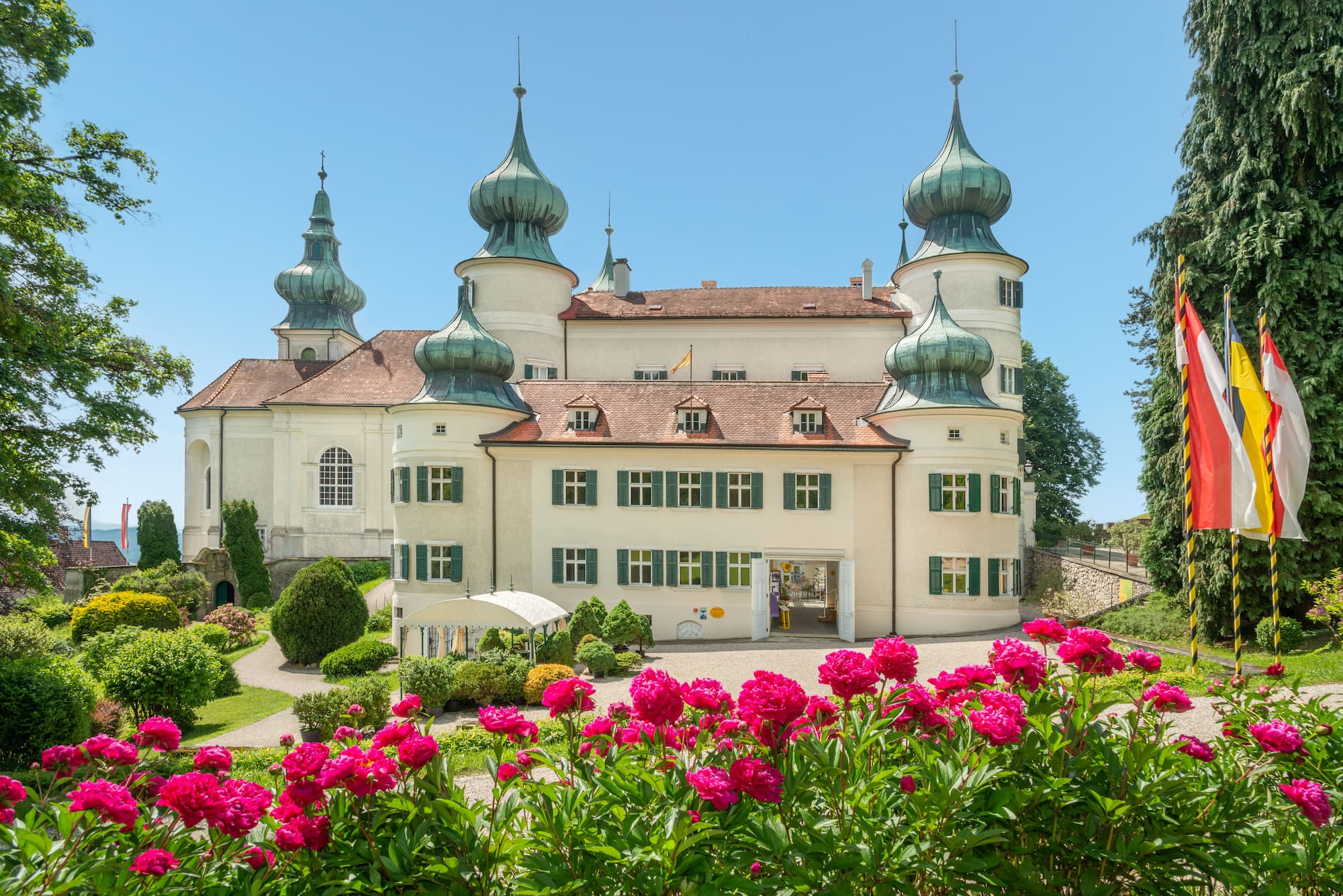
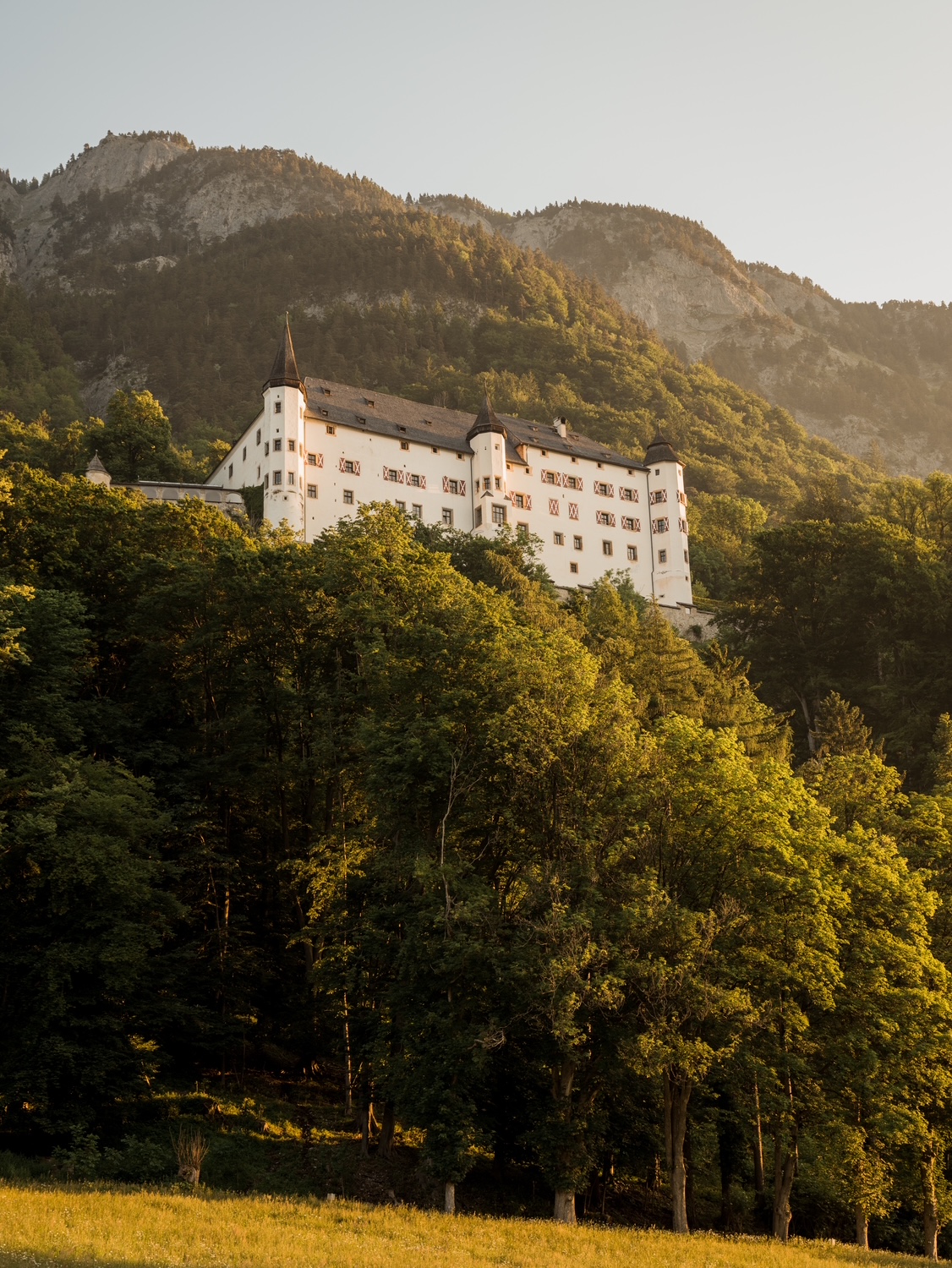
The photograph of the castle: Haslinger
The Art of Entertaining
One might imagine that entertaining at Schloss Artstetten involves elaborate dinners, impeccable table settings and a certain amount of ceremony.
Countess Alix, however, prefers something rather more relaxed.
When friends come to stay, she particularly enjoys organising picnics outdoors, making the most of the gardens and countryside. Spontaneity and informality appeal to her, even if achieving either in a château of such grandeur may occasionally require a little organisation.
Her years in France have also shaped her appreciation of hospitality.
She observes that lunch and dinner occupy a particularly important place in French life. Both the French and Austrians enjoy coming together around the table, although their customs and approaches differ.
It is a combination that seems to suit her: French appreciation for the pleasures of the table, Austrian family traditions and a personal preference for entertaining without unnecessary fuss.
Five Things for a Parisian Apartment
We could not resist asking the interior designer in Countess Alix a rather mischievous question.
If she could take just five things from Schloss Artstetten to furnish a little apartment in Paris, what would she choose?
“A chandelier, of course,” she replies.
Light, she explains, makes everything.
Then come the little knick-knacks, family portraits and photographs — the familiar objects that give a room its character and make a home unmistakably one’s own.
It is a revealing answer. For all the grandeur and historical significance of Artstetten’s collections, the things she would choose are those that bring beauty, atmosphere and personal memories into everyday life.
And what might one find in the Countess’s wardrobe?
A little Parisian chic and a little Austrian practicality.
Rather like the woman herself, one suspects.
A Dinner Across the Centuries
And if Countess Alix could invite absolutely anyone, living or from another century, to dinner at Artstetten, who would she choose?
Her answer comes without hesitation: Archduke Franz Ferdinand and his wife, Sophie.
It is a choice that brings us full circle, back to the history that lies at the heart of Schloss Artstetten.
Franz Ferdinand, heir to the Austro-Hungarian throne, and Sophie, Duchess of Hohenberg, made Artstetten an important part of their family story. Their assassination in Sarajevo in June 1914 set in motion the events that led to the First World War. Today, they rest together in the family crypt beneath the castle church.
For Countess Alix, they are not simply figures from the history books, but her own ancestors, whose portraits, possessions and memories remain woven into the fabric of the home in which she is raising her children.
One can almost imagine the scene: a beautifully laid table, candlelight catching the crystal, and two guests from another century returning, if only for an evening, to the castle that has preserved their memory.
What conversations might unfold across that table?
It is a tantalising thought, and perhaps the most extraordinary dinner party Artstetten could ever host.
A Life Between Two Worlds
There is something particularly appealing about Countess Alix’s approach to life at Artstetten.
She understands the importance of the castle’s history without allowing it to define every aspect of her existence. She has known the freedom of Paris, established a career of her own, and returned to a home whose responsibilities extend far beyond the usual demands of family life.
She is both an interior designer with an appreciation for beauty and a mother who knows that five children require rather more practical arrangements than any grand château might suggest.
The castle’s distinguished past is never far away. It is present in the portraits, the furniture, the chapel, the customs and the landscape. But it is equally present in the affection and respect with which the family continues to inhabit it.
And perhaps that is what makes Artstetten so captivating.
Behind the history books, the formal rooms and the centuries of inherited tradition, there is a family getting up early, gathering for Sunday lunch, disappearing into the woods and occasionally being summoned home by the sound of a cowbell.
At Schloss Artstetten, history may be extraordinary. Life, Countess Alix would have us believe, is wonderfully normal!
Interviewed by Elena Capel Cure