In conversation with Count Ulrich and Countess Katrin Goëss-Enzenberg
There are houses that impress you with their history, and others that seduce you with their beauty. Schloss Tratzberg does both — and then, rather wonderfully, reminds you that it is still a family home.
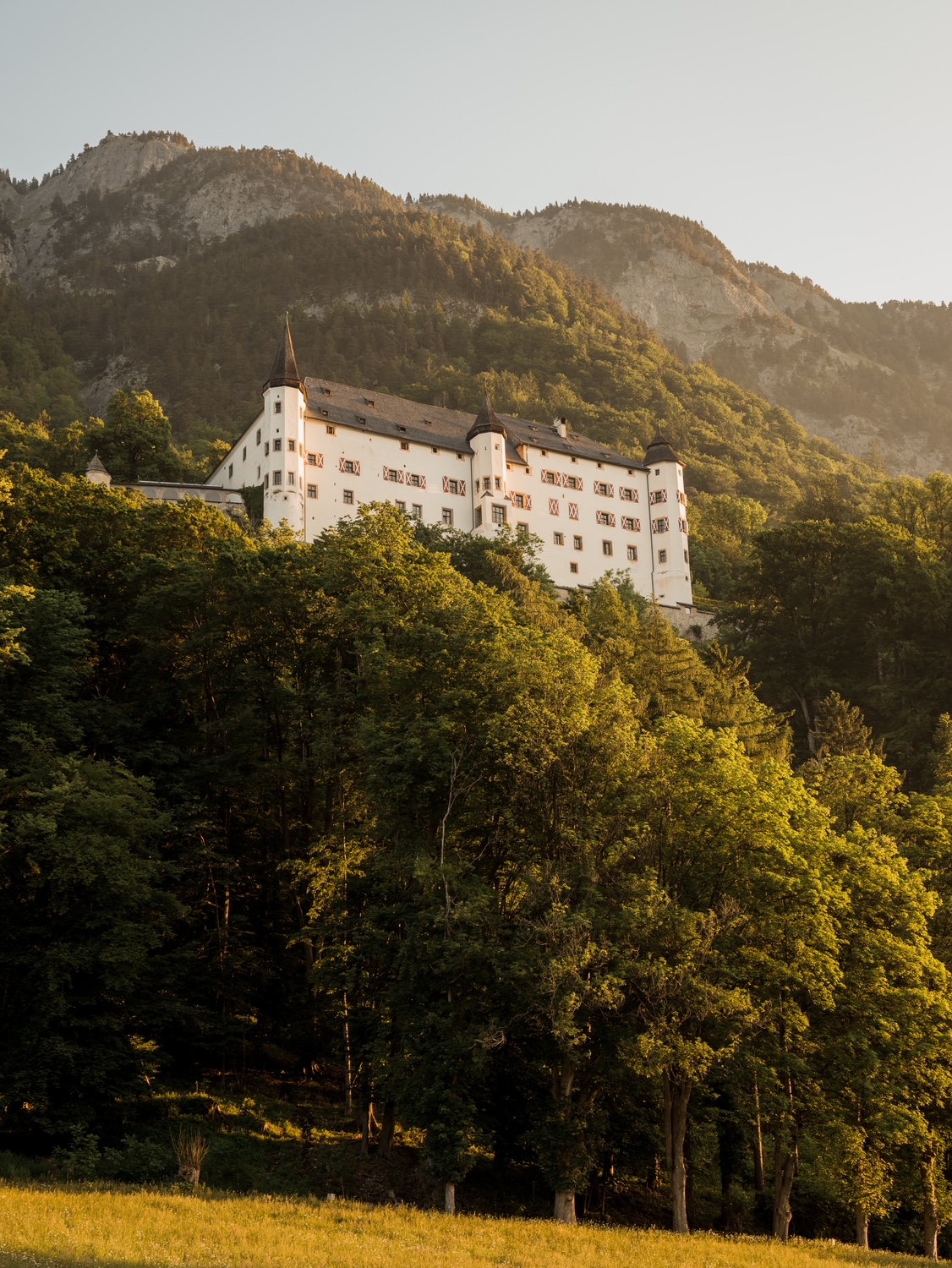
High above the Inn Valley, framed by the mountains of the Tyrol, Tratzberg appears almost improbably romantic. White walls rise through the forest; turrets punctuate the roofline; and beyond them, the mountains climb steeply into the distance. From below, it has something of the fairy tale about it.
Up close, however, another Tratzberg begins to emerge.
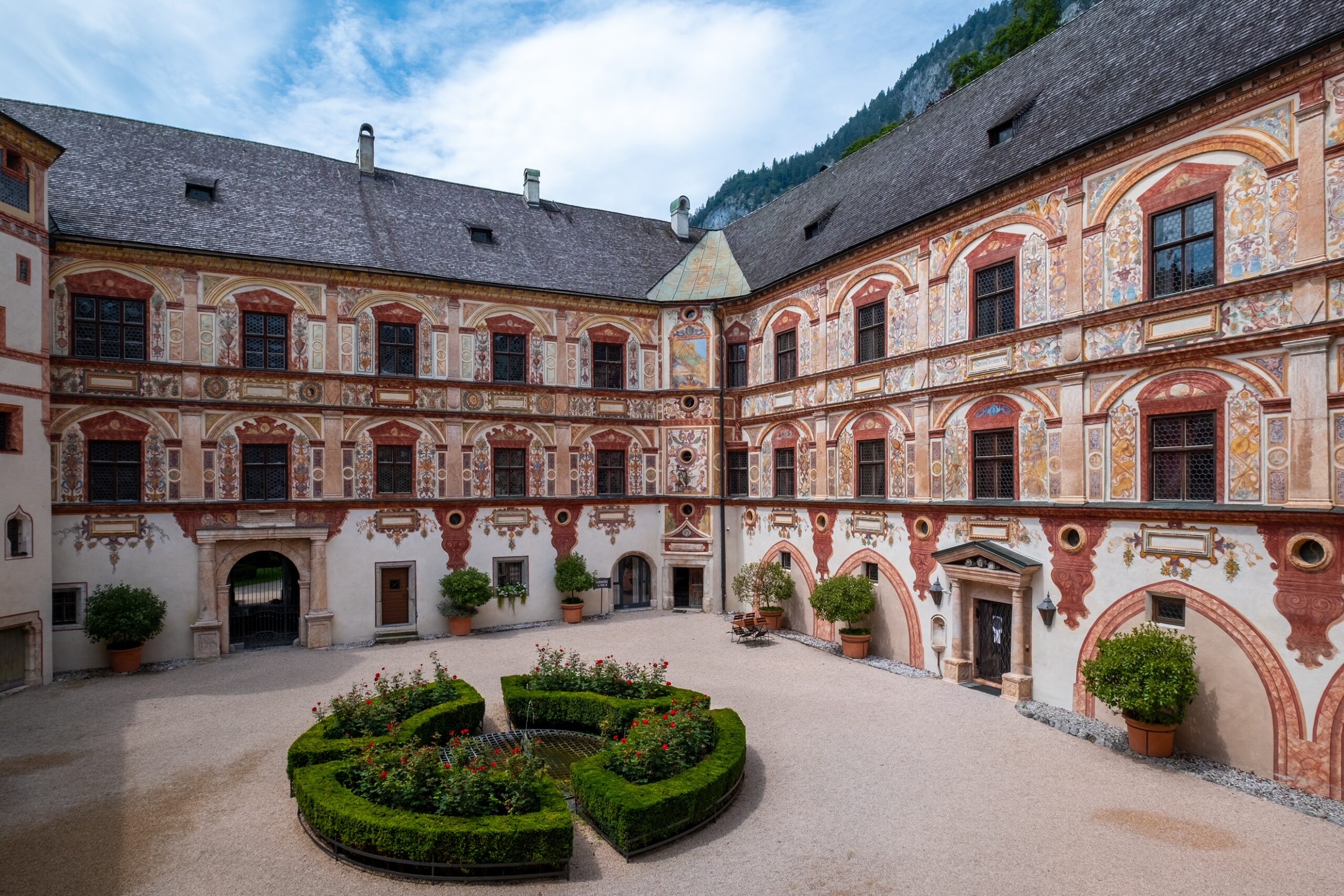
Step through its doors and the scale becomes more intimate. The celebrated Renaissance courtyard is covered in extraordinary painted decoration; centuries-old rooms retain the evidence of the generations who came before; and then, amongst all that history, there are the unmistakable signs of contemporary family life.
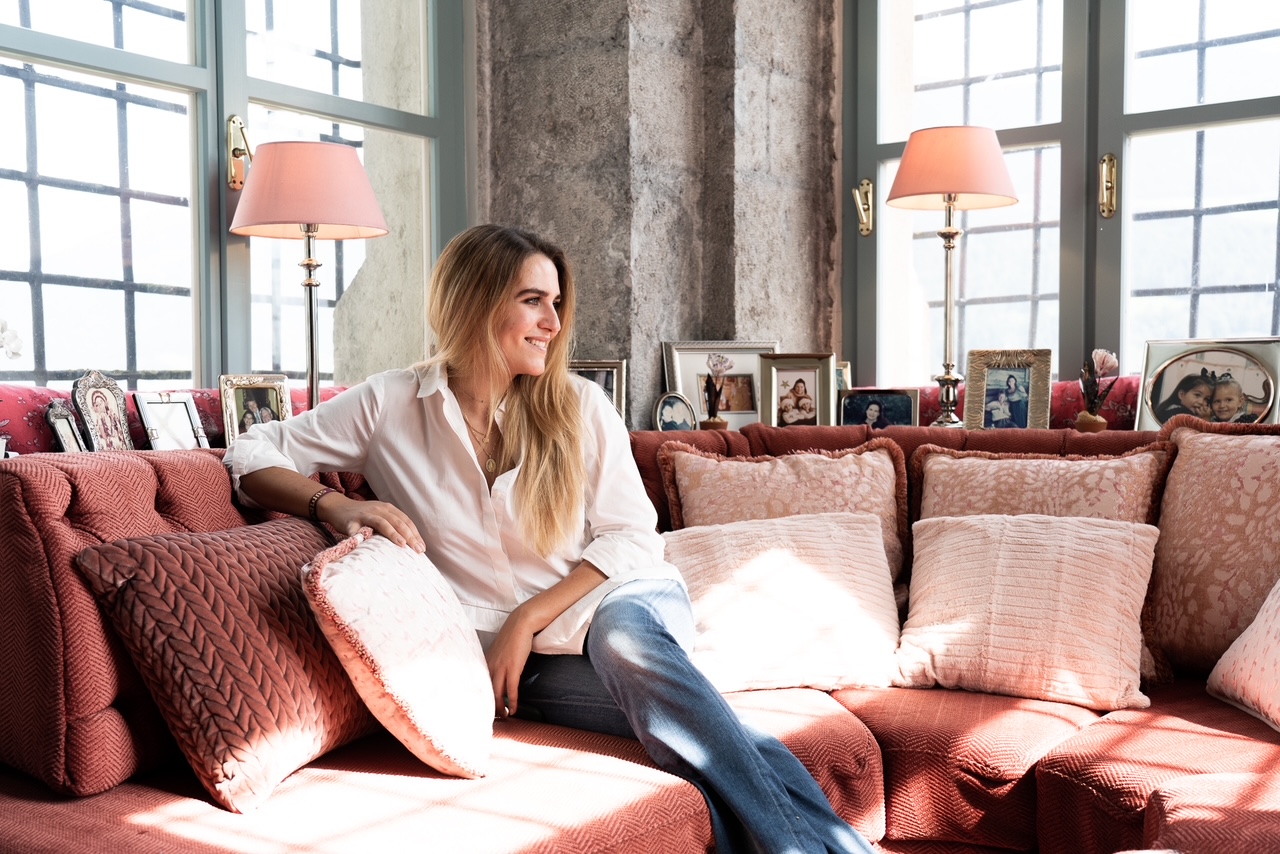
Photographs crowd the tables. Sofas are deep and comfortable. Dogs appear. The formality one might expect from a castle of such importance gives way to something considerably more appealing: the feeling of a house that is genuinely lived in.
For Count Ulrich and Countess Katrin Goëss-Enzenberg, Tratzberg is not simply an architectural inheritance to be preserved behind velvet ropes. It is home — and one that their family has taken on the considerable responsibility of carrying into another generation.
That distinction is perhaps what makes the castle so compelling.
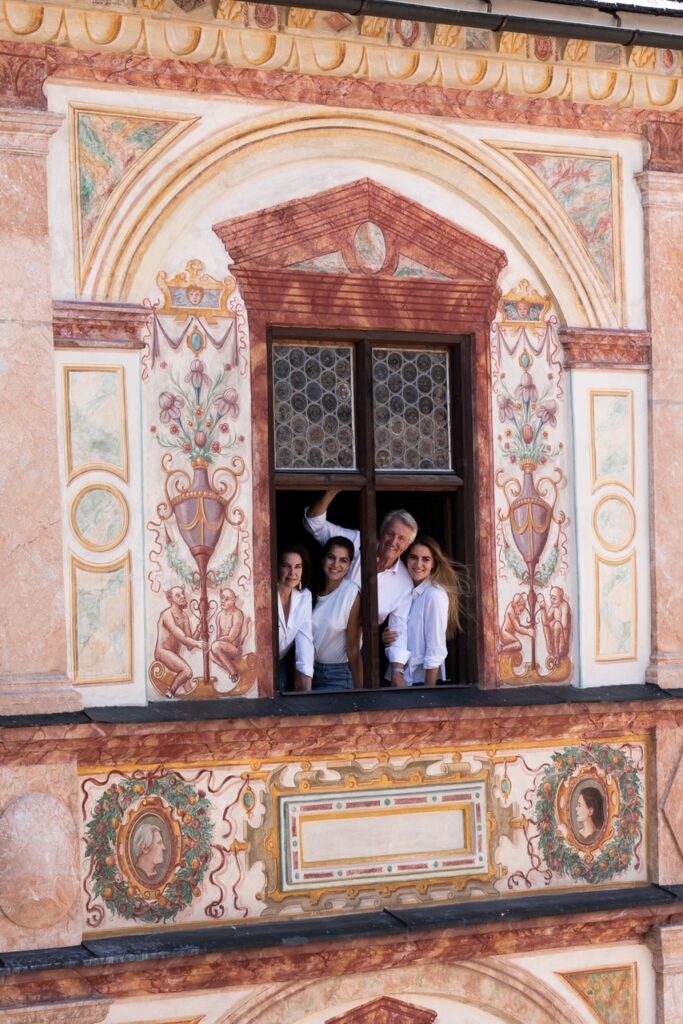
The great European houses that remain most alive are rarely the ones frozen at a particular moment in history. They are the ones where the past is allowed to coexist with the present: where an ancestral portrait can overlook an ordinary family morning, where an ancient window frames someone curled up on a sofa, and where children grow up understanding that history is not an abstract thing. It is quite literally all around them.
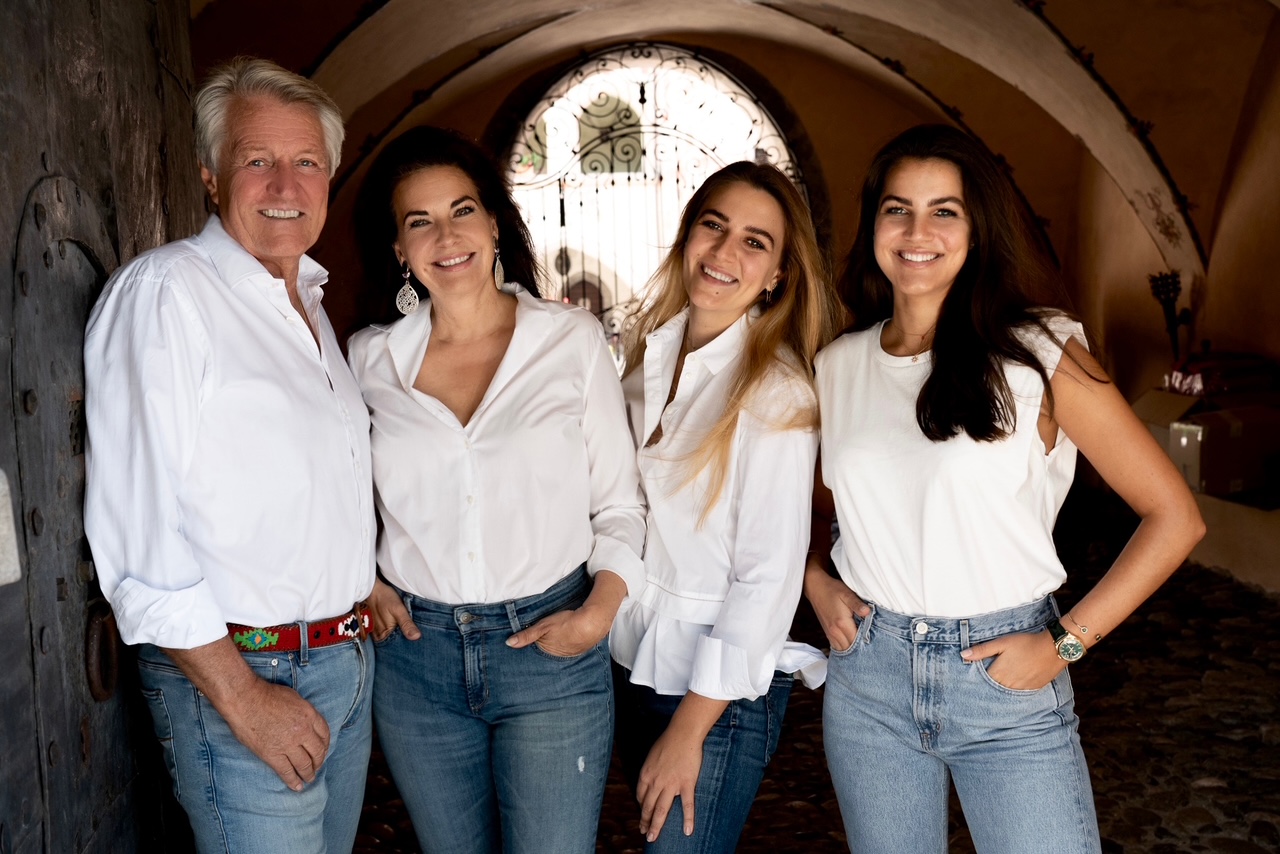
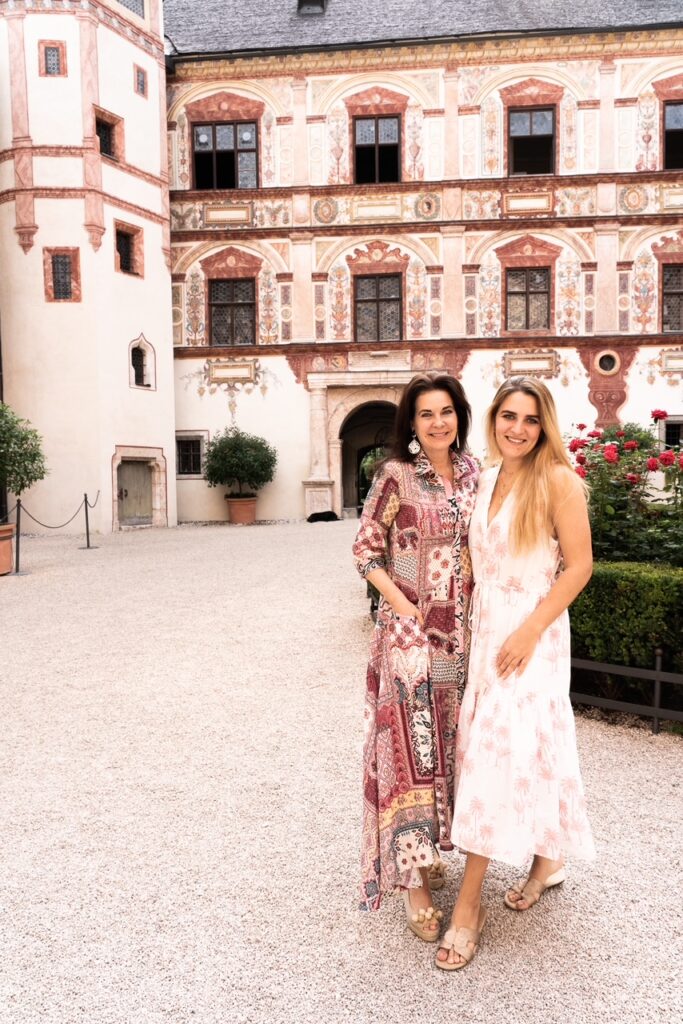
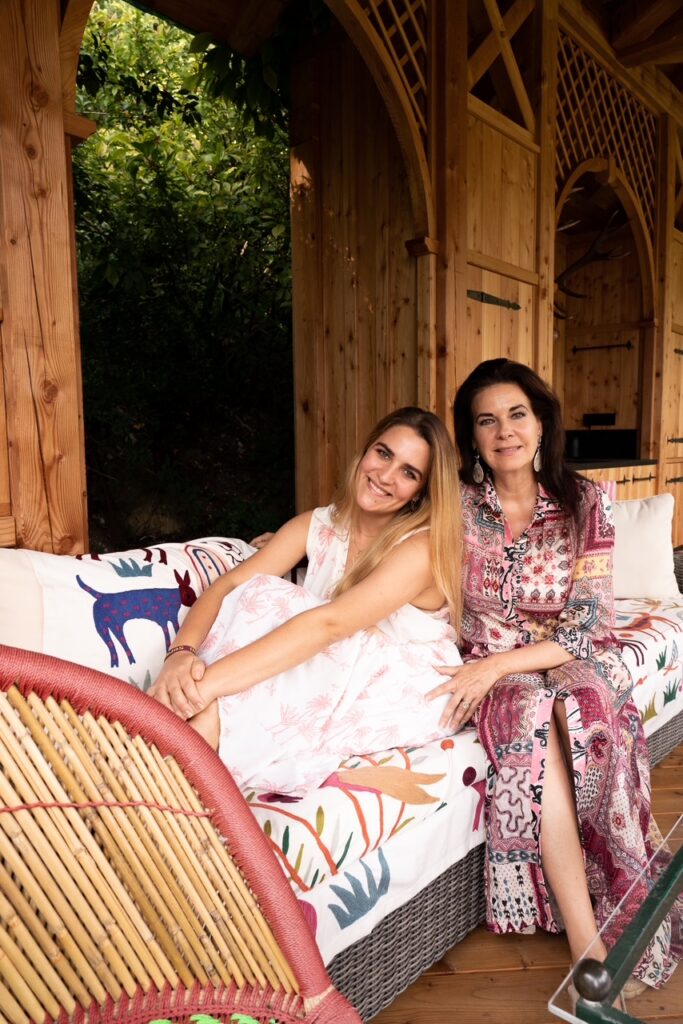
There is an ease to the Goëss-Enzenberg family photographs that says rather more about Tratzberg than any inventory of its treasures could. The family dressed simply in white shirts and denim; mother and daughter together in the courtyard; Philline sitting at ease amongst cushions and family photographs.
The juxtaposition is irresistible: Renaissance grandeur and blue jeans.
And perhaps that is the secret.
Because maintaining a house such as Tratzberg in the twenty-first century requires considerably more than nostalgia. It requires imagination, pragmatism and an understanding that heritage survives only when people continue to find a place for it in their lives.
For Countess Katrin, there is also the particular question faced by every woman who becomes custodian of an old family house: how do you make something inherited feel like your own home without erasing what came before?
At Tratzberg, the answer seems to lie in layering.
Old and new. Formal and informal. Family and history. Preservation and everyday life.
It is this combination — the extraordinary and the everyday — that makes Tratzberg particularly fascinating to us at Blue Ribbons & Lace.
We wanted to know what it really means to live in one of Austria’s great historic houses. How does a family preserve something that has survived for centuries while allowing it to remain a home? What traditions matter? What changes? And what does the next generation hope to carry forward?
From family life and preservation to love, weddings and the future of Tratzberg, Count Ulrich and Countess Katrin Goëss-Enzenberg invite Blue Ribbons & Lace inside the life of the castle.
THE INTERVIEW
1. Count Ulrich, your family traces its lineage to remarkable historical figures including Empress Maria Theresa, Emperor Maximilian I and Philip the Handsome. What does this extraordinary heritage represent to you personally today?
As guardian and protector of Tratzberg Castle, it is a great honour for our family to be able to continue this special heritage. Tratzberg Castle was once in the possession of my ancestor Emperor Maximilian I, which is why this connection is particularly close to us. In the Habsburg Hall is the pedigree of Emperor Maximilian, on which both he and his son Philip the Fair are depicted. In addition, we can still show our guests the original guest suite Emperor Maximilian.
There is also a special connection to Empress Maria Theresia. Through my Goëss grandmother, a born Countess of Meran, I am related to Emperor Maximilian I. And Maria-Therasia on the one hand. In addition, another ancestor of mine was her closest friend and lady-in-waiting. Her name was Sophie Baroness of Schackenberg. The empress suggested that she marry a Count Enzenberg, who was then governor of Tyrol. From this connection, we have preserved 86 original letters handwritten of the empress to her friend and lady-in-waiting. These unique documents are now also kept in the Habsburg Hall at Tratzberg Castle and give a fascinating insight into this time.
All these testimonies make history come alive for us. They remind me every day how important it is to preserve Tratzberg Castle as a place of history and culture and to pass on this heritage to future generations.
2. Count Ulrich, how old were you when you inherited Tratzberg Castle, and what did that moment mean to you?
I took over the property at the age of 38 in 1993 from my mother’s brother. He was childless and it was my grandfather’s wish that he would adopt his sister’s sons in this case. I was long prepared for this moment to come. The trust that my uncle placed in me at that time, at this young age, of course, made me very proud and allowed me the freedom to develop the property economically. We were young and Dynamic and didn’t think so much about the responsibility that was given to me. That protected my wife and me a little from feeling this burden, which such a possession also means. Ultimately, Tratzberg Castle is not only an important cultural heritage for us, but above all our home – a place where history and family life are combined every day anew.
And Countess Katrin, when you first saw the castle, what were your impressions, and at what point did you realise it would become such an important part of your life?
My then friend and today’s husband showed me Tratzberg in 1990, while driving by from the valley with the words: “look, that is Tratzberg up there. I’ll take it over one day!” I looked up, where the castle towered menacingly over me and thought to myself: “Oh dear, the poor woman who will marry this man!” I could never have imagined at the time that I would be the one who lands up there. On a cold, gray day in February 1991, I came to Tratzberg for the first time. On the way up I felt like the protagonist in the movie “Rebecca”. Behind every curve, my heart beat a little faster with fear of what awaits me. Then Tratzberg lay in front of me, cold, gray and dismissive. The then administrator, a Countess Taxis, opened the large, heavy castle gate. I walked through it fearfully, but when I entered this magnificent Renaissance courtyard, my heart opened. The house took me in its arms and never let me go.
3. Tratzberg has undergone an ambitious programme of restoration over the years. Could you tell us a little about the vision behind these renovations, and the balance between preserving the castle’s remarkable history while creating a welcoming family home?
The historic rooms were in a perfect condition, after which my family saved it from decay 160 years ago. Since that time, my family has devotedly taken care of the preservation of this cultural jewel and put an enormous amount of money into it. However, it was never the main residence of the family, because my family traveled from castle to castle 50 years ago and only lived approx. here for 6 weeks a year. When my wife and I moved here all year round, our goal was to create a family home. To make this possible, we first had to create separate entrances for our family and for our visitors, as well as establish a private living area for ourselves. This required a significant investment in renovation, but it laid the foundation for us to open our home to thousands of visitors each year without our family life being affected too much. At first we even thought about closing it completely to the public, but we also saw a cultural-historical mission in leaving it accessible to visitors, because there are many castles that are older than 500 years, but these are no longer originally furnished from the time but only have isolated exhibits. That is the special thing about Tratzberg and we wanted to continue to show that. My wife then wrote a radio play guide, which is spoken by actors, which makes the tour very lively. In addition, she has also written a fairy tale tour for children, which inspires our youngest visitors very much.
4. What led you to make Tratzberg Castle your permanent home, rather than simply a family residence to visit from time to time?
It was my wife’s suggestion. She thought it was important that our children grow up together with Tratzberg, because neither I nor previous generations grew up here and therefore have roots here. We only protect what we love and if they are emotionally connected to an old house because you were born and raised in it, then you are also ready to make high financial sacrifices and continue to preserve it. As soon as you think rationally about the financial outlay, no one would do that voluntarily, but emotions are just not rational.
5. Many of our readers have young families and are themselves custodians of historic homes. What advice would you offer to those raising children in houses that carry so much history?
My advice would be to really live in such a property and preserve it as a home, so that children get the emotional bond to such a house and thus become part of this story. Then, of course, they also have to learn a profession that allows them the financial means to continue to maintain it. When children grow up in such an environment, they naturally develop a special appreciation for tradition, culture and responsibility. A historic house is not just a building – it is a home that writes new stories with each generation.
6. Every historic house has its own personality. Is there a particular room within Tratzberg that feels most like home to you, or one that you naturally gravitate towards at the end of a busy day?
Yes, there are two rooms where I feel especially at home and comfortable. On the one hand, this is the so-called Jägerstube, a wood paneled room that was equipped around 1560 with a beautiful stove and a high marble column. We left it pretty much as it always was. On the other hand, it is the living room with the large, open fireplace, which feels like home to me. We like to spend time there as a family and can come to rest after an busy day. In addition to the Jägerstube, my wife has made the other private rooms more modern.
7. We understand that a number of the castle’s interiors have been preserved remarkably intact over the centuries. Is there a particular piece of furniture, work of art or treasured object within the collection that holds a special place in your hearts, and why?
A very special piece for me is a tournament picture from the year 1509, which shows a tournament of Emperor Maximilian I. In front of the golden roof in Innsbruck. It has a special ideal value for me, because according to the historical inventory lists it has been located on Tratzberg Castle since the completion of the castle around 1509. It is fascinating to know that this work of art has remained here for generations and is still part of the history of the castle.
8. It is said that Emperor Franz Joseph I and Empress Elisabeth (“Sisi”) once visited Tratzberg Castle. Does knowing that such distinguished figures once walked these halls add another dimension to daily life at the castle, or have they simply become part of its living history?
We have several old guest books, which we also show our visitors. One begins in 1842 with the visit of Emperor Franz Joseph, who shot his first chamois here at the invitation of my great-great-grandfather. But in this book, many personalities of history have entered such as the Queen Mother of Sweden and Norway or Prince Albert I of Monaco and also many artists, such as the painter Carl Spitzweg, who has drawn many studies here in the castle, some of which we even have. There are even photos of how the then crown prince couple Archduke Franz Ferdinand and his wife, Archduchess Sophie visited Tratzberg, who shortly after, on the 28th. June 1914 were shot in Sarajevo, which was the trigger of the First World War.
To this day we have had many well-known personalities who have looked at Tratzberg, including the then Secretary of State of the USA, Madeleine Albright (she came with over 50 people from the Secret Service for her protection). But she was very relaxed sitting in our living room and then even had dinner at the Schlosswirt afterwards. Also many Hollywood actors such as Robert Wagner or George Hamilton or guests from the international nobility came to see the castle. It’s sometimes a strange feeling who went through the house here and wrote history. Such historical events make the past tangible and remind us that Tratzberg Castle was not only a witness to important history, but also actively witnessed it.
9. More recently, Tratzberg Castle provided the magnificent setting for the wedding celebrations of Her Royal Highness Archduchess Gabriella of Austria. What did it mean to you to see the castle become part of such a joyful royal occasion, continuing a tradition of celebration that spans centuries?
A Habsburg wedding in the Habsburg Hall was already a special event. We were happy that the wedding could take place at all, because it was just a very tight time window during Corona. There were some representatives of royal houses here. The crown, which Archduchess Gabriella wore to the wedding, was delivered and guarded the day before with security officers from Luxembourg in a special casket. Such occasions show that Tratzberg Castle is still a place where history remains alive and special moments are celebrated. We are filled with joy to be able to continue this centuries-old tradition of festive gatherings.
10. Today, Tratzberg Castle also welcomes couples from around the world who choose to celebrate their weddings and special occasions within its historic walls. What do you hope guests take away from their experience, and what makes Tratzberg such a memorable setting for life’s most important celebrations?
I hope they recognize the uniqueness of this historic house and have awe of the extraordinary craftsmanship they see here. One should not forget that it was created by people who possessed incredible abilities to produce this art with relatively simple tools. In addition, I hope that guests here also recognize the enormous efforts we make here to preserve this cultural jewel for posterity. Starting your married life in this ambience is already unique from these points of view.
11. A castle has witnessed generations of love stories long before our own. When couples choose Tratzberg as the setting for their wedding, what do you hope they carry with them from this extraordinary place into their own married lives?
Perhaps that love for something or someone means to put yourself in second place sometimes or often, so that something even bigger can arise. This is no different in marriage than in preserving a castle like Tratzberg. In addition, I wish that our guests remember Tratzberg Castle not only as an impressive historical building, but above all as a place full of atmosphere, warmth and lived history. The most beautiful moments in life deserve a special setting – and that’s exactly what Tratzberg offers. We are happy when people celebrate their wedding or another important festival here and Tratzberg becomes part of their very personal history. When our guests go home with unforgettable memories and like to think back to that day and this place, then we have reached our goal.
12. Countess Katrin, every historic house reflects, in subtle ways, the personality of the woman who calls it home. Over the years, how have you made Tratzberg your own while respecting its extraordinary history?
For me, it was primarily important that we do not have to completely subordinate ourselves to the history out of sheer awe. A castle like Tratzberg draws its history from the past, but that alone does not contribute to the future. I wanted to make sure that we feel comfortable and safe here, so that the many small and large sacrifices we have to make are worth it. I am a person who loves nature, colors, patterns, fabrics and also modern art. All this brings a lot of warmth and security into the old walls and thus present history can be written again.
Tratzberg is not built as a museum, but a whole that has grown over time. Every generation has left its stamp on the castle and that represents the house to this day. If you only subordinate yourself to the old, to history, the present loses its chance for growth and thus its liveliness. It’s going to die and I definitely wanted to avoid that here.
13. Finally, if Tratzberg Castle could leave just one lesson for future generations about beauty, family and living well, what do you hope that lesson would be?
I think it’s the lesson of thinking and acting much longer-term. Today’s generation wants quick success, quick money, the least effort and work. We have become summit climbers! The only thing that counts is what peaks we have reached and no longer the way there. The lesson of Tratzberg should be: Effort, perseverance and dedication is worthwhile and last much longer than the short-term enjoyment, the short-term pleasure or the quick and easy way. This is no different with the castle than with health and also applies to the success and functioning of a family.
Discover Schloss Tratzberg
Beyond its celebrated history, Schloss Tratzberg offers an extraordinary setting for weddings and private celebrations, where centuries of heritage provide the backdrop for a new chapter of one’s own.
For visits, weddings and further information, discover Schloss Tratzberg.