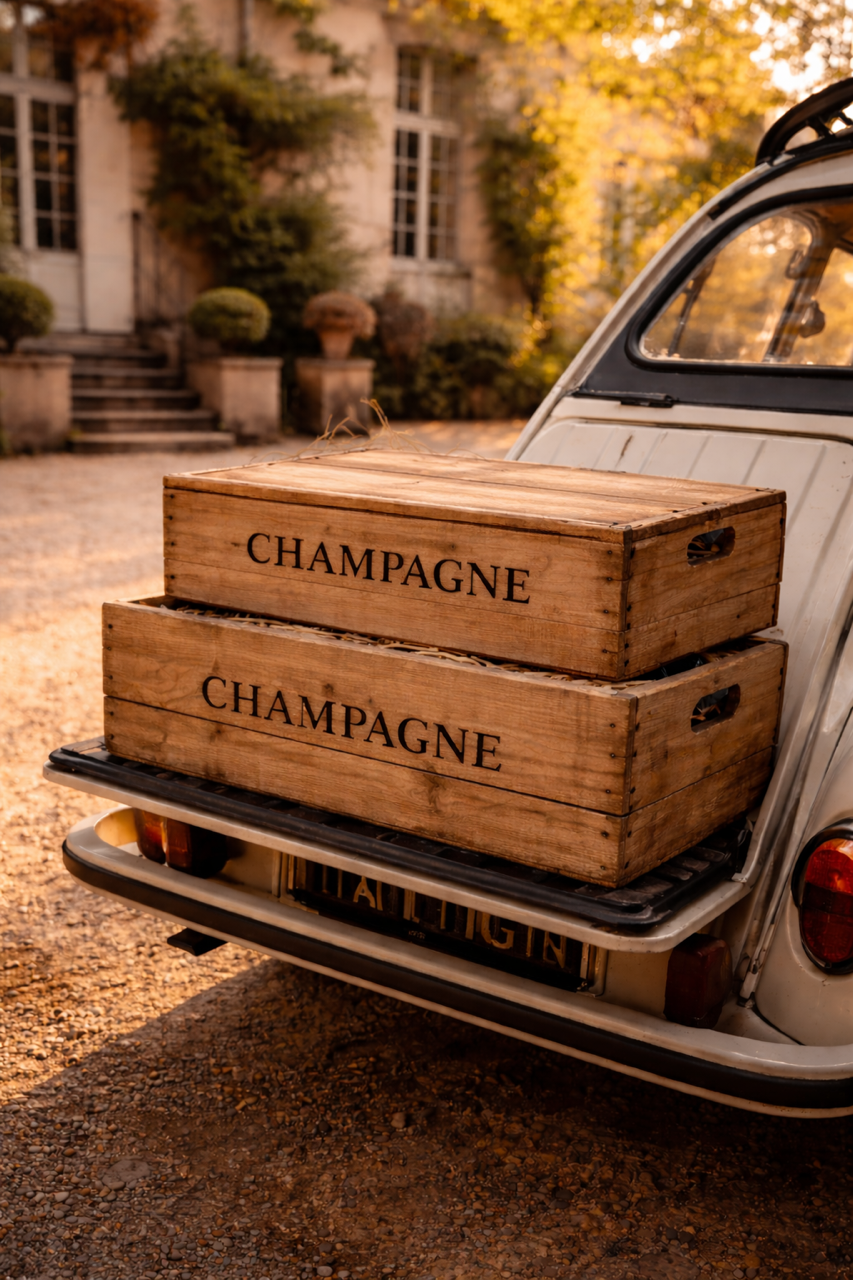
Champagne need not wait for celebration. As the evenings draw in, these are the bottles we want to open.
There is a tendency to think of Champagne in seasons of celebration.
Christmas. Weddings. Birthdays. New Year’s Eve.
Autumn is quieter about it.
Perhaps that is precisely why Champagne feels so right at this time of year.
The first properly cold evening. Friends arriving for supper. A bottle opened while something cooks in the oven. A glass poured on Sunday before lunch. The particular pleasure of coming home as dusk falls and deciding that an ordinary evening deserves something better.
In summer, we want Champagne cold and bright.
By autumn, our tastes change.
We begin to look for wines with a little more depth: Pinot Noir, longer ageing, reserve wines, richer vintages and bottles that can follow us from the first glass through supper.
This is our autumn Champagne list.
Not necessarily the grandest bottles.
The ones we would most like to have waiting.
The Bottle for Friday Evening
There should always be one Champagne in the house that requires no deliberation.
Not the bottle being saved.
The bottle to open.
For early autumn evenings, we like a Brut with a generous proportion of Pinot Noir: dry, structured and substantial enough to feel at home once the weather cools.
Serve it properly cold, but not icy.
And resist the temptation to keep Champagne exclusively for guests.
There is considerable pleasure in opening a bottle at six o’clock on a Friday simply because the week has ended.
Pour two glasses.
Put something salty on a plate — Comté, gougères, salted almonds, perhaps a few slices of saucisson.
Nothing more is required.
Blanc de Noirs for the First Fires
If summer belongs naturally to the delicacy of Chardonnay, autumn makes us reach for Blanc de Noirs.
Made entirely from dark grapes — Pinot Noir, Pinot Meunier, or a combination of the two — these Champagnes often have a broader, deeper character.
Think baked apple rather than lemon.
Brioche rather than blossom.
Spice, toasted nuts and sometimes something faintly smoky.
It is Champagne with enough presence to sit beside a fire.
A Blanc de Noirs is particularly good with roast chicken, mushrooms, pâté en croûte or a simple plate of charcuterie.
It is also one of those rare wines that can begin beside the fire before dinner and remain on the table once everyone sits down.
Vintage Champagne for Sunday Lunch
Vintage Champagne asks for a little more attention.
Unlike non-vintage Champagne, which brings together wines from different years to create a consistent house style, vintage Champagne comes principally from one declared harvest and spends considerably longer developing before release.
The result can be extraordinary in autumn.
Older bottles begin to show the flavours we instinctively want at this time of year: toast, hazelnut, pastry, dried fruit, spice.
This is not the Champagne we would pour hurriedly into a flute.
Give it a proper wine glass.
Let it lose the first edge of its chill.
And put it on the Sunday lunch table.
A mature vintage Champagne can be magnificent with roast poultry, buttery sauces, aged Comté or a mushroom dish.
Champagne is, after all, a wine.
Sometimes the best way to appreciate it is to forget that it sparkles.
Rosé After Summer
Rosé Champagne does not disappear when summer does.
It simply changes company.
In July, we drink it outside.
In October and November, its red-fruit character makes much more sense alongside food.
Look for a rosé with structure rather than sweetness: Pinot-led wines with notes of wild strawberry, raspberry, spice and perhaps a little toast from ageing.
It is particularly lovely with duck.
It can also be surprisingly good with charcuterie and harder cheeses.
And there is something undeniably beautiful about a glass of pale copper-pink Champagne against an autumn table.
The Grower Champagne
Autumn is also a good moment to become curious.
Alongside the great Champagne houses are the smaller grower-producers — families who cultivate their own vineyards and make Champagne from their own grapes.
Their bottles can speak very specifically of a village, a vineyard or a particular piece of land.
Some are precise and mineral.
Others are broad, vinous and wonderfully idiosyncratic.
We like keeping one unfamiliar grower Champagne in the cellar.
A bottle bought because somebody recommended it.
A label we have not seen before.
Something to open with friends and discuss around the table.
Not every bottle needs a famous name.
Discovery is part of the pleasure.
The Champagne to Drink with Truffles
There are foods that make Champagne seem suddenly more serious.
Truffles are one of them.
With their deep, earthy perfume, they call for Champagne with age and complexity — ideally something with Pinot Noir, mature reserve wines or several years on the lees.
Serve it with the simplest possible dish.
Soft scrambled eggs with truffle.
Fresh pasta with butter and truffle.
Or a baked potato split open at the table with butter, salt and generous shavings over the top.
The Champagne provides freshness.
The truffle provides everything else.
Demi-Sec for Pudding
The bottle most often missing from a Champagne collection may be one of the most useful.
Demi-Sec.
Sweeter than Brut, it was once a far more familiar style and deserves rediscovery, particularly when pudding arrives.
Dry Champagne can taste unexpectedly severe beside something sweet. Demi-Sec has enough dosage to meet dessert rather than fight against it.
In autumn, pour it with an apple tart, tarte Tatin, poached pears or a simple cake made with almonds.
It is also rather wonderful on its own at the end of a long lunch.
The Magnums
And then there are magnums.
Autumn is when invitations become less formal.
Someone stays for supper.
Two people become six.
Lunch extends into the afternoon.
For those occasions, a magnum is one of the most useful things to have waiting.
There is generosity in placing one on the table that a standard bottle never quite manages.
It immediately suggests that nobody should be counting glasses.
Champagne also ages particularly well in magnum, where the proportion of wine to oxygen encourages a slower evolution.
Keep one for a celebration, certainly.
But keep another without deciding what it is for.
Those bottles have a habit of finding their own occasions.
What We Are Putting Away Now
If we were filling a Champagne shelf for the months ahead, it would be a small and deliberate collection:
• A dependable Brut for Friday evenings.
• A Pinot-led Blanc de Noirs for fireside drinks and autumn suppers.
• A vintage bottle for Sunday lunch.
• A structured rosé for the table.
• A grower Champagne we have never tried before.
• A mature bottle for truffles and richer dishes.
• A Demi-Sec for puddings.
• And at least one magnum, waiting without a particular date attached to it.
Because perhaps the nicest thing about having Champagne in the house is not knowing exactly when it will be opened.
Autumn brings enough occasions of its own.
The first fire.
A friend who stays for dinner.
Sunday lunch that runs late.
Rain against the windows.
A dish that turned out particularly well.
Or simply the discovery, somewhere towards the back of the cellar, that there is a bottle cold enough to open.