The dress is chosen for a day. The veil can belong to a century.
There is a moment, just before a bride leaves for the ceremony, when someone reaches for the veil.
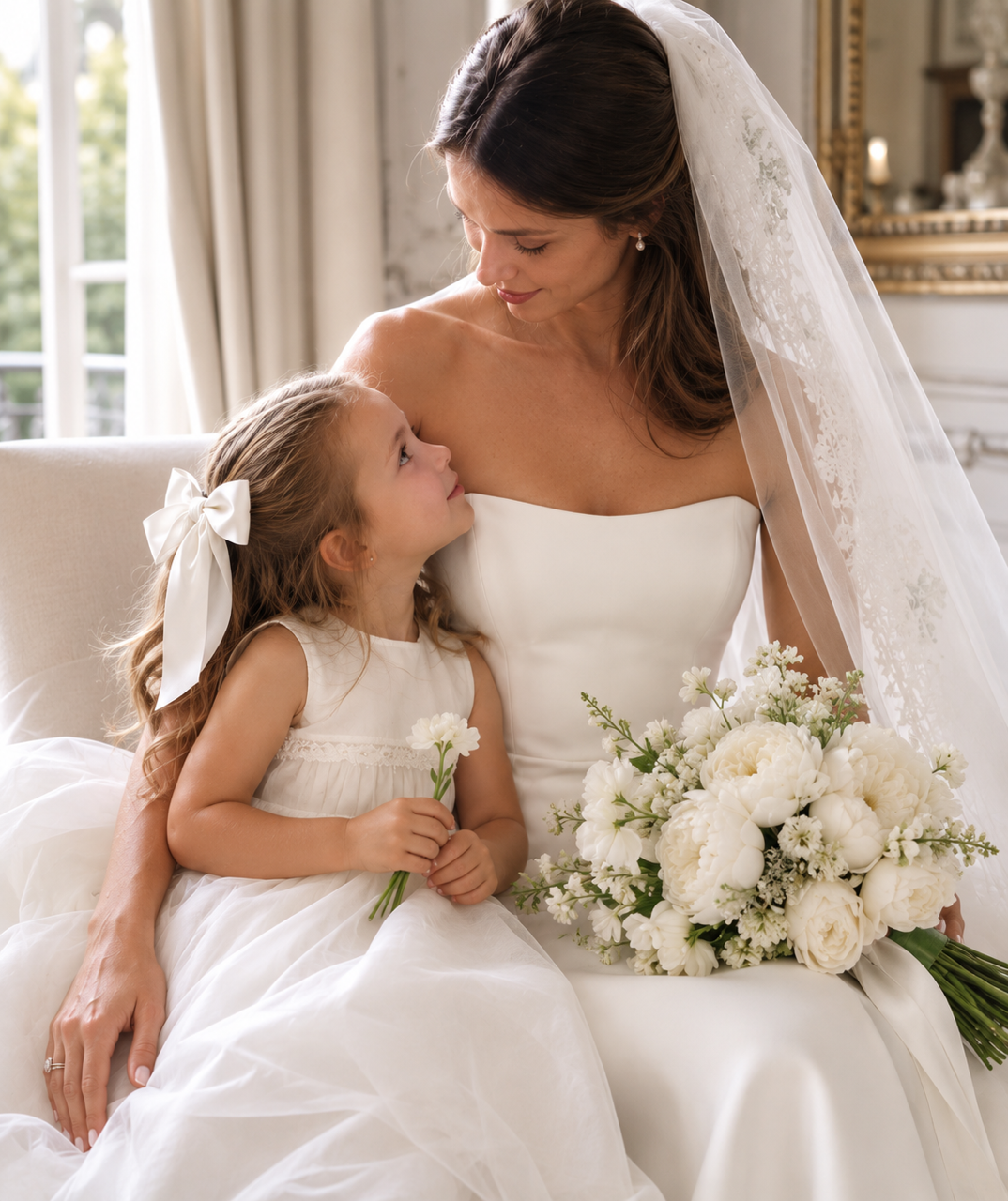
Perhaps it is her mother. Perhaps a sister, an aunt, a grandmother. Hands lift the lace carefully, almost instinctively more gently than they would lift the dress. It is placed over the bride’s hair, fastened beneath a tiara or a simple comb, and suddenly something changes.
She is no longer simply wearing her wedding dress.
She is a bride.
Of all the pieces associated with a wedding, the veil may be the most emotional because it is the one least concerned with fashion. A silhouette dates. A neckline changes. Sleeves disappear and return. Bouquets become loose, then architectural, then wild again.
But lace has a different relationship with time.
And in certain families, the veil does not merely survive the changing fashions of weddings. It survives the weddings themselves.
The groom changes.
The dress changes.
The church changes.
The country house, cathedral or château changes.
The flowers change, the decade changes, the photographs change.
But the veil remains.
There is something extraordinarily romantic in that.
The Veil That Waits
In aristocratic and royal families, clothing has long carried meaning beyond its beauty. Jewels are inherited. Christening gowns are carefully stored. Silver is engraved. Linen is monogrammed. Objects become witnesses to family life.
But the wedding veil occupies a particularly intimate place among them.
Unlike a tiara, it is not principally a symbol of rank. Unlike a jewel, its value cannot be measured by carats.
Its luxury lies in its fragility.
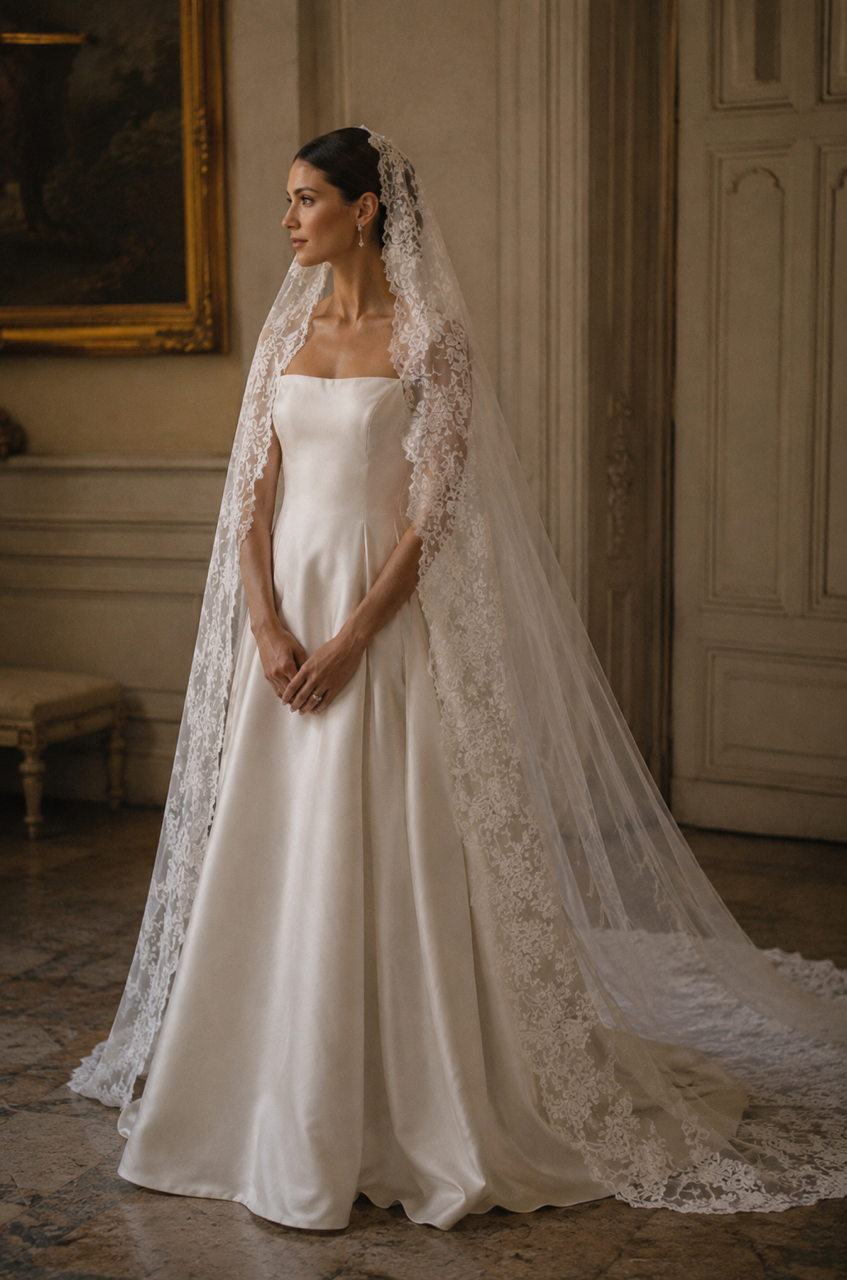
A great lace veil can require hundreds, even thousands, of hours of work. Flowers, leaves, scrolls and borders emerge slowly from thread. And once completed, this seemingly weightless object can outlive the hands that made it.
Folded into tissue and put away after one wedding, it waits.
Perhaps for twenty years.
Perhaps for fifty.
Perhaps for a century.
Then another bride opens the box.
The Belgian Veil
Few royal wedding traditions express this more beautifully than the antique Brussels lace veil associated with Queen Paola’s family.
Its story reaches back to the nineteenth century. The veil was originally created for Paola’s Belgian ancestor Laura Mosselman du Chenoy, who married Fulco Ruffo di Calabria in 1877.
Decades later, Paola Ruffo di Calabria wore the lace for her own marriage to Prince Albert of Belgium in 1959.
And then something wonderful happened.
The veil continued.
Princess Astrid wore it for her wedding in 1984. Mathilde d’Udekem d’Acoz wore it when she married the future King Philippe in Brussels in 1999. Claire Coombs wore it when she married Prince Laurent in 2003. And in 2022, another generation appeared beneath its lace when Princess Maria Laura wore the family veil for her marriage to William Isvy.
Five very different women. Five different dresses. Five different marriages.
One veil.
Look at the photographs beside one another and the remarkable thing is not that the veil looks old.
It doesn’t.
It looks eternal.
That is the peculiar magic of beautiful lace: it seems to belong equally to 1877, 1959, 1999 and today.
A Royal Language of Lace
Across Europe’s royal weddings, the veil has often been the element that turns a beautiful dress into an image that enters history.
When Máxima Zorreguieta married the future King Willem-Alexander of the Netherlands in Amsterdam in 2002, Valentino created an extraordinarily restrained ivory Mikado gown. Behind it fell a long silk-tulle veil, hand decorated with floral and scrolling lace motifs.
The dress was architectural; the veil brought romance.
Two years later, Letizia Ortiz arrived for her wedding to the future King Felipe VI of Spain beneath another magnificent veil. Hers was ivory silk tulle, hand embroidered with symbolic motifs including ears of wheat and the fleur-de-lis. It was a wedding gift from Felipe himself.
Queen Mathilde’s veil told a different story. Hers was not commissioned for the occasion at all. Beneath the drama of her Édouard Vermeulen wedding gown was the antique Brussels lace already carrying the history of another royal bride.
And this is where the distinction becomes interesting.
Some royal veils are created to tell the story of a marriage.
Others already contain the story of a family.
Both can be magnificent. But the inherited veil possesses something that even couture cannot manufacture overnight:
memory.
More Than Lace
There is a temptation when planning a wedding to believe that everything must be new.
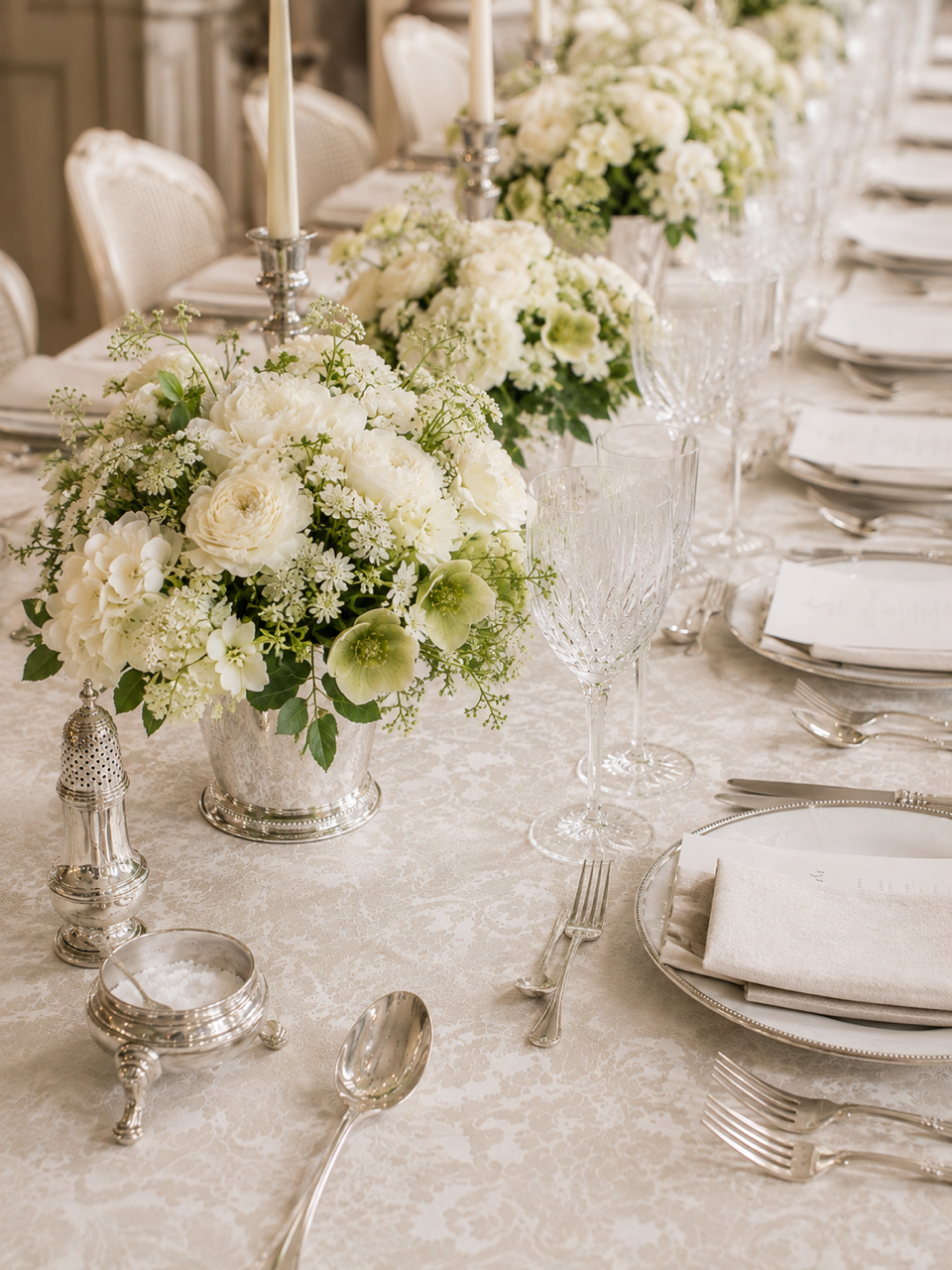
A new dress. New shoes. New table linen. New flowers. New stationery. New jewels.
But some of the most affecting weddings contain something old not because tradition requires it, but because continuity does.
A veil can carry that continuity more beautifully than almost anything else.
Imagine knowing that the lace falling over your shoulders once fell over your grandmother’s.
That the scalloped edge touching your hand appears in a faded wedding photograph on a mantelpiece.
That somewhere in an album is your mother, or aunt, or great-grandmother, turning toward the church doors beneath precisely the same flowers worked into precisely the same lace.
The women are different.
Their lives will be different.
Their marriages will be different.
Yet for a few hours, separated perhaps by decades, they inhabit the same veil.
That is not simply an accessory.
It is a thread between generations.
Begin Your Own Tradition
One does not need to inherit a nineteenth-century Brussels lace veil to possess an heirloom.
Someone, after all, has to be the first bride.
This may be the most beautiful reason to choose a lace wedding veil today: not only for how it will look when you walk into the ceremony, but for what it might become afterwards.
Choose lace worth keeping.
Look for craftsmanship rather than decoration for decoration’s sake. Fine Chantilly, delicate Brussels-inspired florals, handmade appliqué, embroidery worked onto silk tulle—something whose beauty reveals itself when held close.
And consider resisting the temptation to make it too perfectly matched to the dress.
An heirloom must be able to travel.
Today’s bride might wear it with an ivory silk column. Her daughter may choose a romantic gown with sleeves. A granddaughter might wear it over something startlingly simple.
The veil should belong to all of them.
After the wedding, have it professionally cleaned and conserved. Store it properly, away from light and moisture, wrapped in acid-free tissue rather than forgotten at the back of a wardrobe.
And write down its story.
The date.
The place.
Who made the lace.
Who wore it first.
Perhaps tuck a photograph inside the box.
Because one day, many years from now, another bride may open it.
Her wedding will bear almost no resemblance to yours.
The flowers will be different. The music will be different. The dress will certainly be different.
Even the idea of what makes a beautiful wedding may have changed.
And that is precisely the point.
Everything changes.