Markets, Makers, Food & the Art of Sicilian Living
Palermo is not a city that reveals itself quietly.
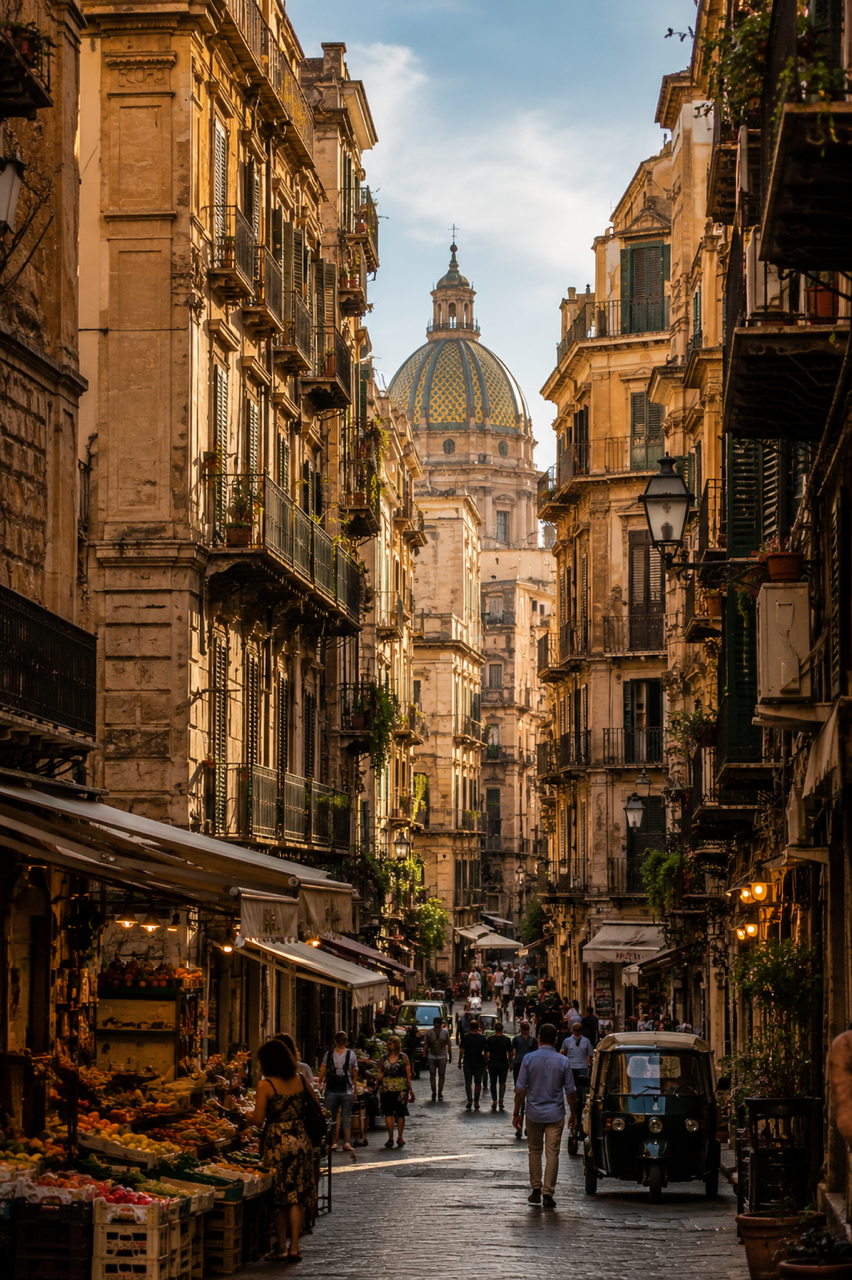
It arrives in layers: the call of a market vendor, the scent of citrus and frying panelle drifting through a narrow street, laundry moving between balconies, faded façades glowing in the afternoon sun and, every so often, an enormous carved doorway opening onto a world you would never have guessed existed beyond it.
Sicily’s capital is beautiful, certainly. But it is not polished beauty.
Palermo is theatrical, generous, imperfect and intensely alive. Arab, Norman, Spanish and Italian influences sit alongside one another, sometimes within the very same building. Centuries overlap here. Grand palazzi stand a few streets from crowded markets; Baroque churches appear unexpectedly at the end of tiny lanes; elegant drawing rooms exist behind façades marked by time.
And everywhere, there is food.
To understand Palermo, you have to taste it.
Morning at the Market
Begin early, when the city is still shaking itself awake.
Palermo’s historic markets are among its great pleasures. Ballarò, Capo and Vucciria each have their own character, but all offer that wonderful sensory abundance particular to Sicily.
Crates overflow with tomatoes, aubergines, artichokes and lemons. Fish lie gleaming on beds of ice. Bundles of wild herbs sit beside enormous wheels of cheese. Vendors call across their stalls while shoppers discuss what is good that morning and what should be cooked for lunch.
Food here is not separated from daily life. It is daily life.
Stop for something simple.
A warm panelle tucked into bread. Arancine with their crisp golden shells. Perhaps sfincione, Palermo’s soft, deeply savoury answer to pizza.
Then an espresso, taken standing at the bar.
There is plenty of time for ceremony later.
At the Sicilian Table
Palermo’s cooking tells the story of everyone who has passed through Sicily.
There is sweetness beside salt, citrus with fish, breadcrumbs where another region might use cheese, raisins and pine nuts folded into savoury dishes. Pasta con le sarde brings together sardines, wild fennel, saffron, raisins and pine nuts in a combination that seems to contain the island itself.
Then there are involtini, caponata, baked anelletti, fresh fish and vegetables prepared with remarkably little interference.
For a taste of old Palermo, Antica Focacceria San Francesco has been part of the city’s food story for generations, serving many of the classics of Palermitan cooking.
And afterwards, something sweet.
Cannoli filled only when they are ordered. Cassata in its extravagant colours. Almond pastries. Granita. Pistachio in seemingly endless forms.
One particularly lovely stop is I Segreti del Chiostro, inside the former Dominican monastery of Santa Caterina. Its pastries draw upon Palermo’s extraordinary tradition of convent baking, preserving recipes once passed quietly from one generation of cloistered nuns to the next.
Palermo reminds you that eating well does not necessarily mean eating elaborately.
It means beginning with something good.
And knowing what to do with it.
The Shops Worth Looking For
Shopping in Palermo is best approached with curiosity rather than a list.
Move away from the obvious souvenir shops and look for the places that still feel connected to Sicily: small ceramic studios, linen and textile shops, antique dealers, independent food stores and workshops where things are made rather than merely sold.
Sicilian ceramics bring flashes of colour—lemons, palms, flowers and traditional motifs—while beautiful linens and embroidered pieces speak to another, quieter tradition of the island.
Food shops are particularly difficult to leave empty-handed.
Bottles of local olive oil. Sea salt from western Sicily. Pistachios. Almonds. Preserves. Chocolate. Dried herbs and beautifully wrapped sweets all have a way of finding space in one’s suitcase.
But some of Palermo’s best discoveries have no famous name attached to them.
They are the tiny shop glimpsed through a doorway, the artisan recommended over lunch, the antique plate found at the back of a cabinet.
Palermo rewards wandering.
Behind the Doors of Palermo
And then there are the palazzi.
They are essential to understanding the city.
Palermo’s aristocratic houses tell stories of families, politics, changing fortunes and a particular Sicilian relationship with beauty. Some have been magnificently restored. Others retain the patina of centuries: worn stone, old silk, ancestral portraits, tiled floors and rooms where nothing feels newly arranged for visitors.
Among them, Palazzo De Gregorio holds a special fascination.
Its importance is not simply architectural. What makes a historic house compelling is the sense that it continues to have a life beyond its history.
Palazzo De Gregorio feels precisely that way.
It is a place connected to generations of one family and, at the same time, to Palermo itself—a house in which the distinction between history and everyday life becomes wonderfully blurred.
We previously had the pleasure of speaking with its owner, Principe Antonio De Gregorio, about the Palazzo, his family and the extraordinary history contained within its walls.
Read our conversation: Palazzo De Gregorio: The Living Heart of Palermo.
[Blue Ribbons & Lace link to be inserted here]
What stays with us is this idea of the living palazzo.
Not a museum.
A home.
That difference matters.
Because the most interesting historic houses are not necessarily those in which everything has been preserved perfectly behind ropes. They are the ones where doors still open, tables are still laid, recipes are remembered, stories are told and the rooms continue to acquire memories.
It is easy to imagine why the kitchen and table have always been so important in houses such as these. In Sicily, hospitality is inseparable from food.
And food is inseparable from family.
A City of Palazzi
De Gregorio is part of a much larger story.
Throughout Palermo, remarkable palazzi offer glimpses into different periods of the city’s aristocratic and cultural life. Some announce themselves with monumental staircases and elaborate façades; others remain almost secret behind comparatively restrained entrances.
Visiting them changes the way you see Palermo.
The city outside suddenly begins to make sense—the scale of the buildings, the courtyards hidden behind enormous doors, the balconies looking down onto the streets.
But Palazzo De Gregorio offers something particularly appealing: the feeling of continuity.
Palermo has never been frozen in time.
Neither should its great houses be.
The Luxury of Everyday Life
Perhaps the loveliest thing about Palermo is the way beauty appears in ordinary moments.
A tablecloth hanging from a balcony.
A bowl piled high with lemons.
An elderly gentleman reading his newspaper outside a café.
Flowers being carried home from the market.
A family gathering for Sunday lunch.
An aperitivo that becomes dinner because nobody feels particularly inclined to leave.
There is an ease to Sicilian hospitality that can be deceptive. Behind apparently effortless meals lie recipes learned over generations, ingredients bought from trusted vendors and an instinctive understanding of how a table brings people together.
It is a kind of luxury that has very little to do with extravagance.
It is the luxury of time.
Of cooking for people.
Of sitting at the table long after the plates have been cleared.
Palermo, Slowly
Palermo should not be rushed.
See the cathedral and the extraordinary Norman architecture. Step inside its churches. Visit its palazzi.
But leave space between them.
Walk through the markets. Follow a street simply because it looks interesting. Buy something from a maker. Have another coffee. Sit somewhere beautiful at aperitivo hour and watch Palermo pass by.
And, above all, eat.
Because somewhere between the market stall and the palazzo dining room, between a paper-wrapped panelle and a table laid beneath a chandelier, Palermo begins to reveal itself.
Its grandeur and its simplicity are not opposites.
They belong together.
Perhaps that is what makes the city so seductive.
Palermo does not ask you merely to admire its beauty.
It invites you to live, however briefly, inside it.
For more information, please see our related interview