The art of creating a beautiful evening—and actually being there to enjoy it.
The best dinner parties have a certain ease to them.
The candles have burned lower than expected. Someone has poured another glass of wine. The conversation has moved far beyond the introductions of the evening, and nobody appears particularly interested in going home.
What guests rarely see are the decisions that made that ease possible.
Because effortless entertaining is rarely effortless. It is considered.
A good host does not attempt to create perfection. They create the conditions for pleasure: food that can wait, lighting that flatters everyone, wine poured generously, music low enough for conversation and enough preparation that, when the doorbell rings, the evening can simply begin.
Consider this the Blue Ribbons & Lace formula for a dinner party worth remembering—and one you will want to give again.
Begin With the Feeling
Before deciding what to cook, decide how you want the evening to feel.
Perhaps it is an intimate autumn supper with candlelight and Burgundy. A long spring dinner with the windows open. A glamorous Saturday evening that begins with Champagne. Or an impromptu kitchen supper for six.
This single decision makes everything else easier.
The menu, flowers, tablecloth, music and wine should all belong to the same world.
You are not decorating a room.
You are creating an atmosphere.
The Guest List
For an intimate dinner at home, six to eight guests is something of a magic number.
It is large enough for conversation to move naturally, but small enough for everyone to remain part of it.
Think less about assembling people who already know one another and more about assembling people who might enjoy knowing one another.
The most interesting tables often contain a little contrast: old friends and new acquaintances, different generations, different professions, someone wonderfully talkative beside someone quietly fascinating.
And if you are making a seating plan, couples need not always sit together.
They already know each other’s stories.
Invitations Set the Tone
A dinner party begins before anyone arrives.
An invitation need not be formal, but it should feel intentional.
Give your guests the date, time and place, and offer some small indication of the evening ahead. “Dinner at eight” suggests something quite different from “Come from seven for Champagne, dinner afterwards.”
For a more formal occasion, send an invitation. For an intimate supper, a thoughtful message is perfectly sufficient.
What matters is that being invited feels like being included in something.
The Menu: Follow a Formula
The easiest way to entertain beautifully is to stop reinventing dinner every time.
Have a formula.
For us, it is:
Something small with Champagne
A simple first course
One beautiful main course
Two accompaniments
Cheese, if the evening calls for it
A dessert made in advance
The individual dishes can change endlessly with the seasons, but the structure remains.
For spring, begin with asparagus and follow with salmon, new potatoes and peas.
In autumn, perhaps burrata and figs before roast chicken, wild mushrooms and pommes Anna.
In winter, make something slow-cooked.
In summer, allow tomatoes, herbs, stone fruit and the grill to do most of the work.
A dinner party does not require six demonstrations of your ability to cook. One or two exceptional things are far more memorable.
Choose Food That Forgives You
This may be the most useful rule in this guide:
Never build a dinner party menu around food that demands your attention at the exact moment your guests need it too.
Choose dishes that can be prepared ahead, held for a little longer than planned or finished in minutes.
Roasts are wonderful. Gratins are wonderful. Tarts are wonderful. A beautiful platter of vegetables at room temperature is wonderful.
Eight individual soufflés, perhaps less so.
When deciding between two dishes, choose the one that allows you to pour yourself a glass of Champagne.
What to Pour
You do not need a different wine for every course.
For most dinners, three bottles or styles are enough:
Champagne on arrival
Brut Champagne is the great opening gesture. Blanc de Blancs is elegant and mineral; rosé Champagne feels especially celebratory.
One wine with dinner
Choose according to the main course. White Burgundy, Sancerre and Chablis are beautiful choices for fish and lighter dishes; Pinot Noir and red Burgundy work particularly well with poultry, mushrooms and autumn flavours.
Something with dessert—or nothing at all
A small pour of Sauternes, Moscato d’Asti or demi-sec Champagne can be lovely when appropriately paired. But coffee after dessert is equally elegant.
The guiding principle is harmony rather than abundance.
And always have sparkling and still water readily available.
Set the Table Before You Cook
Ideally, set the table the night before.
It immediately removes one task from the day itself and gives you time to notice what is missing.
Begin with what you already own.
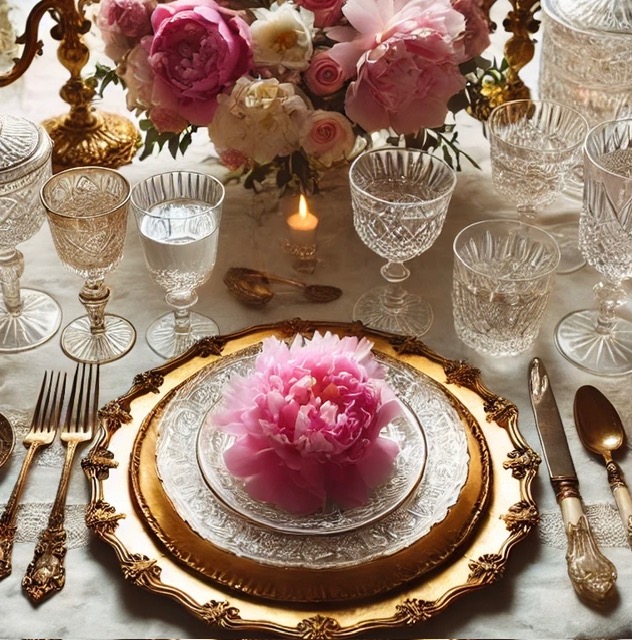
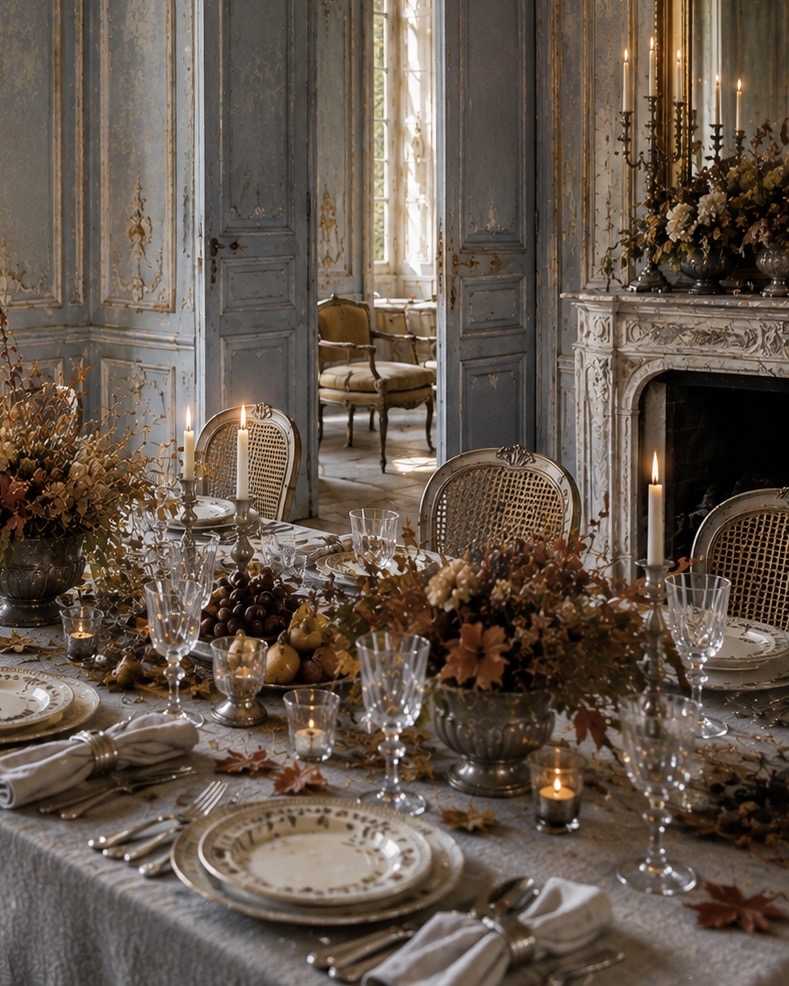
A linen tablecloth—or a bare, beautiful table. Cloth napkins. Proper glasses. Plates you love. Candlesticks collected over years rather than bought as a matching set.
A table becomes interesting through layers, not expense.
Add one or two things that make it feel different from an ordinary evening: handwritten place cards, an antique serving dish, tiny bowls of salt, a beautiful carafe.
The objective is not perfection.
It is the impression that someone cared.
Flowers Should Look Alive
Dinner-party flowers should never prevent two people from seeing one another.
Keep arrangements low, loose and slightly imperfect.
Use several small vessels rather than one enormous centrepiece. Mix flowers with branches, herbs or foliage. Allow stems to bend naturally.
And look outside before visiting a florist.
A branch clipped from the garden, rosemary in a small silver cup or a handful of garden roses can be more beautiful than an elaborate arrangement.
Candlelight Is Non-Negotiable
If there is one transformation worth making, it is this.
Turn off the overhead lights.
Use lamps around the room and candles on the table. Light them before the first guest arrives so that the house already feels different when the door opens.
Candlelight creates intimacy almost instantly.
And everyone looks better in it.
Music Should Be Felt, Not Heard
Create the playlist in advance and make it longer than the evening could reasonably last.
Begin with something light while guests arrive, then allow the music to become warmer as dinner progresses.
Avoid anything so recognisable or loud that it competes with conversation.
You should notice if the music stops.
You should not spend dinner noticing every song.
Before the Doorbell Rings
The final hour should not belong to cooking.
By then, the table should be set. Flowers arranged. Wine chilled. Serving dishes chosen. Kitchen reasonably tidy. Food largely prepared.
Then stop.
Take a shower. Get dressed. Put on music. Light the candles.
Open the Champagne ten minutes before everyone arrives.
Pour yourself a small glass.
There is a remarkable difference between being greeted by a host who is still chopping onions and one who opens the door with a drink already in hand.
When Guests Arrive
Never send guests directly to the dining table.
Give the evening somewhere to begin.
Take coats. Offer Champagne or another aperitif immediately. Have something small to eat within reach.
And resist disappearing into the kitchen.
People take their cues from the host. If you appear relaxed, they relax. If you behave as though dinner being seven minutes late constitutes a catastrophe, everyone feels it.
It doesn’t.
At the Table
Once seated, generosity matters more than choreography.
Bring dishes to the table when possible. A roast on a platter, vegetables in beautiful bowls and potatoes passed from person to person create a completely different atmosphere from restaurant-style plating.
They encourage interaction.
They also make hosting considerably easier.
Keep an eye on glasses without obsessively filling them. Keep water within everyone’s reach. Allow conversation to wander.
And do not begin clearing the instant the final fork touches the plate.